
MCA Debt Consolidation: Costs, Risks, and Legal Options
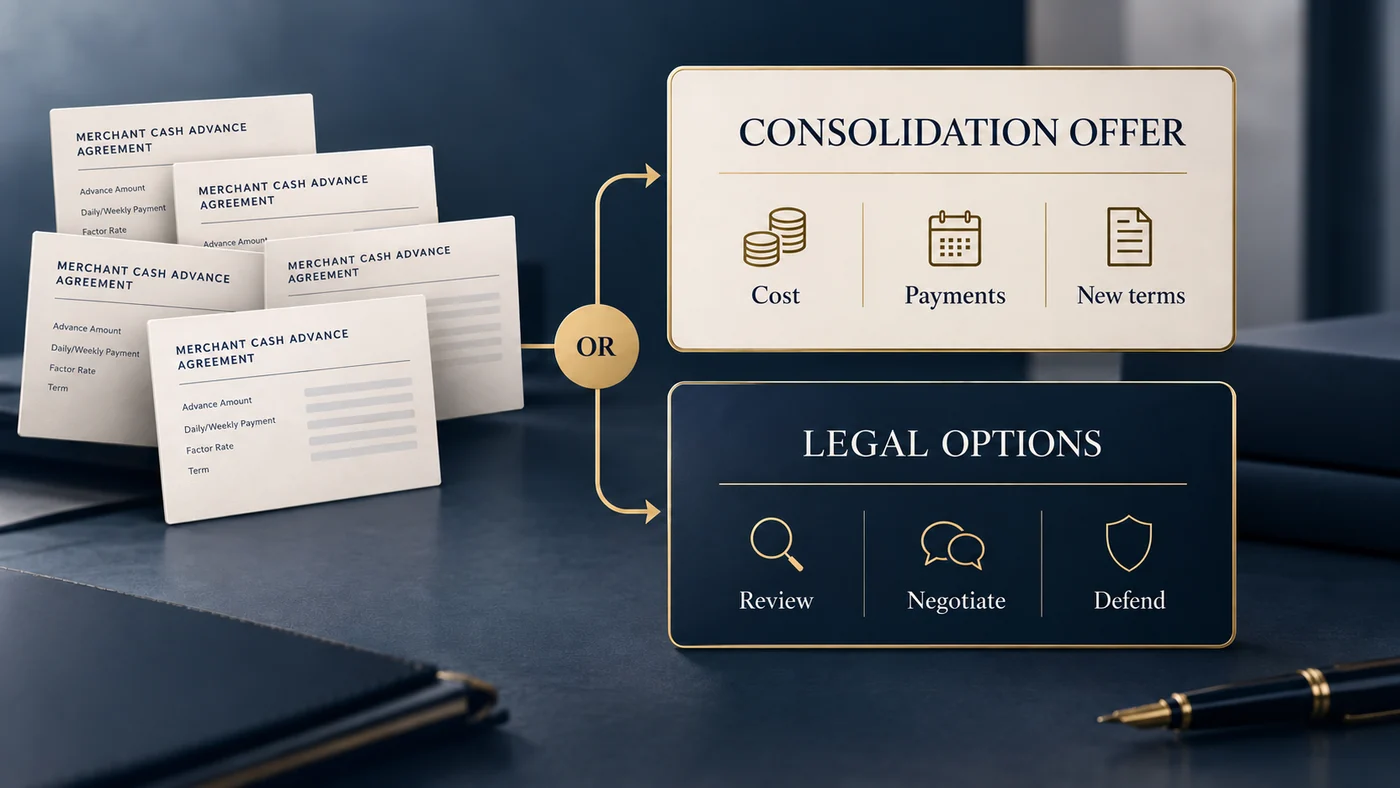
MCA debt consolidation, also called merchant cash advance consolidation, generally uses new financing to pay off existing MCAs. It may simplify payments or reduce the amount leaving your account each week, but the benefit depends on the total cost, the new terms, and whether the original advances are actually paid off.
If several MCA withdrawals are competing with payroll, rent, and operating expenses, start with what the offer changes for your business.
Before you accept a consolidation offer
- What gets paid off? Identify each included MCA, its written payoff amount, and how satisfaction will be documented.
- What will leave your account? Add the new payments to any withdrawals that will continue.
- What is the full cost? Review total repayment, fees, duration, and early-payoff terms.
Business Debt Law Group reviews MCA agreements, proposed financing documents, and related legal issues. We do not arrange or provide consolidation financing. You can request a free MCA review or case evaluation before a lawsuit is filed.
How Does MCA Debt Consolidation Work?
In a payoff consolidation, new financing is used to satisfy specified existing advances. Those obligations are replaced with a new agreement and payment schedule. The new payment may be daily, weekly, or monthly; the word “consolidation” does not establish the schedule or guarantee a lower cost.
Before relying on an offer, identify every MCA being included, obtain written payoff figures, and confirm who will send each payment. The amount advertised by a lender or broker may differ from the amount available after fees and deductions.
Check when the old withdrawals should end, how payments made during the transition will be credited, and what confirms that each account is satisfied. If an advance is left out or only partly paid, its obligations may continue alongside the new financing.
MCA Consolidation Loan vs. Reverse Consolidation
These arrangements address cash flow differently. Read the documents to determine which one is actually being offered.
| Question | Payoff consolidation | Reverse consolidation |
|---|---|---|
| Where does the new money go? | Toward paying off identified existing MCAs. | Funds may be provided over time to help cover existing withdrawals. |
| Do the original MCAs remain? | Accounts included in the payoff should be documented as satisfied. | Original agreements and payment demands may continue. |
| What needs particular attention? | Net funding, complete payoffs, releases, and the new payment schedule. | Combined obligations and what happens if future funding is delayed or stops. |
A reverse consolidation should not be treated as proof that the original balances have been paid off. Map the incoming funding and every outgoing payment across the entire arrangement. See our reverse consolidation guide for related issues.
Compare the Full Cost, Not Just the Smaller Payment
A lower periodic payment can help cash flow while increasing the total amount paid or extending the obligation. Compare the existing arrangements and the new offer using the same information:
- Net funding: the amount available after origination fees, broker charges, and other deductions.
- Total payments: the full amount payable under the new agreement, including any final lump-sum payment and charges paid separately.
- Payment schedule: the amount, frequency, start date, duration, and conditions that allow payments to change.
- Early payoff: whether paying early reduces financing charges or triggers additional fees.
- Remaining obligations: payments on any advance or other financing that will not be paid off.
A Simple Cost Example
Assume the proposed loan pays off all included MCAs, and the figures in the documents are:
| Item | Amount |
|---|---|
| Written payoff amounts for existing MCAs | $60,000 |
| Total payments under the proposed loan | $78,000 |
| Difference above the current payoff amount | $18,000 |
Smaller installments would not change the $78,000 total. Charges excluded from that figure would add to the cost. The $18,000 difference is a dollar comparison, not an APR.
This example does not establish savings compared with completing the existing MCAs; that requires their remaining payment schedules and terms. Compare both the total remaining payments and the timing of withdrawals under each option.
This is a hypothetical illustration, not a financing quote. Use your actual payoff letters and proposed documents, and compare the payment schedule with expected operating cash flow.
Who Qualifies for MCA Consolidation Loans?
Eligibility depends on the provider, financing product, and business’s financial position. There is no single credit score, revenue threshold, or number of bank statements that applies to every offer.
Ask what the provider requires and prepare current bank statements, revenue records, a schedule of all financing obligations, MCA agreements, and written payoff information. Credit history, time in business, payment performance, existing liens, and available collateral may also be part of the review.
What if payments have already been missed?
If you have missed payments or received legal notices, disclose those issues accurately during the review. An advertised approval or preliminary quote is not a substitute for the final terms. Confirm whether the person presenting the offer is the funder or a broker and who will make the financing decision.
Check Guarantees, Liens, and Payoff Documents
A consolidation offer should address more than the amount withdrawn each week. Review any new personal guarantee, collateral requirement, security interest, and restriction on obtaining other financing. Compare those obligations with the agreements being paid off.
For each existing MCA, clarify what documents will confirm satisfaction and whether any guarantee, lien, MCA UCC filing, or related claim requires a separate release or termination. Do not assume a broker’s promise resolves those issues. If a payoff figure expires on a particular date, confirm what changes if funding arrives later.
Keep the final signed agreement, payoff instructions, proof of payment, and any satisfaction or release documents together. These records help identify what was actually completed.
MCA Consolidation Companies and Attorneys Serve Different Roles
A lender evaluates and offers financing; a broker may seek offers from funding sources. An attorney reviews legal rights, obligations, and disputes. Legal review can be relevant even when a business is still considering a consolidation loan.
An MCA attorney can examine existing agreements alongside proposed financing documents, identify unresolved guarantees or claims, and discuss whether negotiations or litigation need attention. Hiring counsel does not guarantee financing, a lower payment, a settlement, or dismissal of a lawsuit.
Before retaining an attorney or another service provider, understand the fees, work included, and who will handle any pending lawsuit. If money will be held for future settlements, ask who holds it, how disbursements are approved, and what withdrawal or refund terms apply. Money accumulated for a possible settlement is not itself payment to the funder.
What if New Financing Does Not Solve the Problem?
Depending on the agreements and circumstances, other issues may deserve review:
- Reconciliation provisions, where withdrawals need to be compared with receivables and the contract’s adjustment terms.
- MCA restructuring, involving proposed changes to existing payment arrangements.
- Negotiated settlement, addressing a specified obligation through agreed terms and documented resolution.
If you have received court papers, a judgment, or an account restraint, seek prompt legal review. Do not assume a financing application or payment discussion suspends a deadline or resolves a pending case. Our MCA lawsuit guide explains related considerations.
Request a Free MCA Review or Case Evaluation
Considering a consolidation offer, managing several MCAs, or already dealing with a collection dispute? Bring your existing agreements, recent payment records, written payoff figures, any proposed financing documents, and legal notices.
Business Debt Law Group can discuss the legal issues in those documents and whether negotiations or other legal assistance may fit your situation. You do not need an active lawsuit to request help. All consultations are free.
Our role is legal review and representation; we do not arrange or provide consolidation financing. The scope and fees for retained legal services are addressed separately.
This article provides general information, not legal advice. Options depend on the documents, applicable law, and individual circumstances. No particular result is promised, and submitting an inquiry does not create an attorney-client relationship.