
Merchant Cash Advance Factor Rates: Cost, Fees and APR
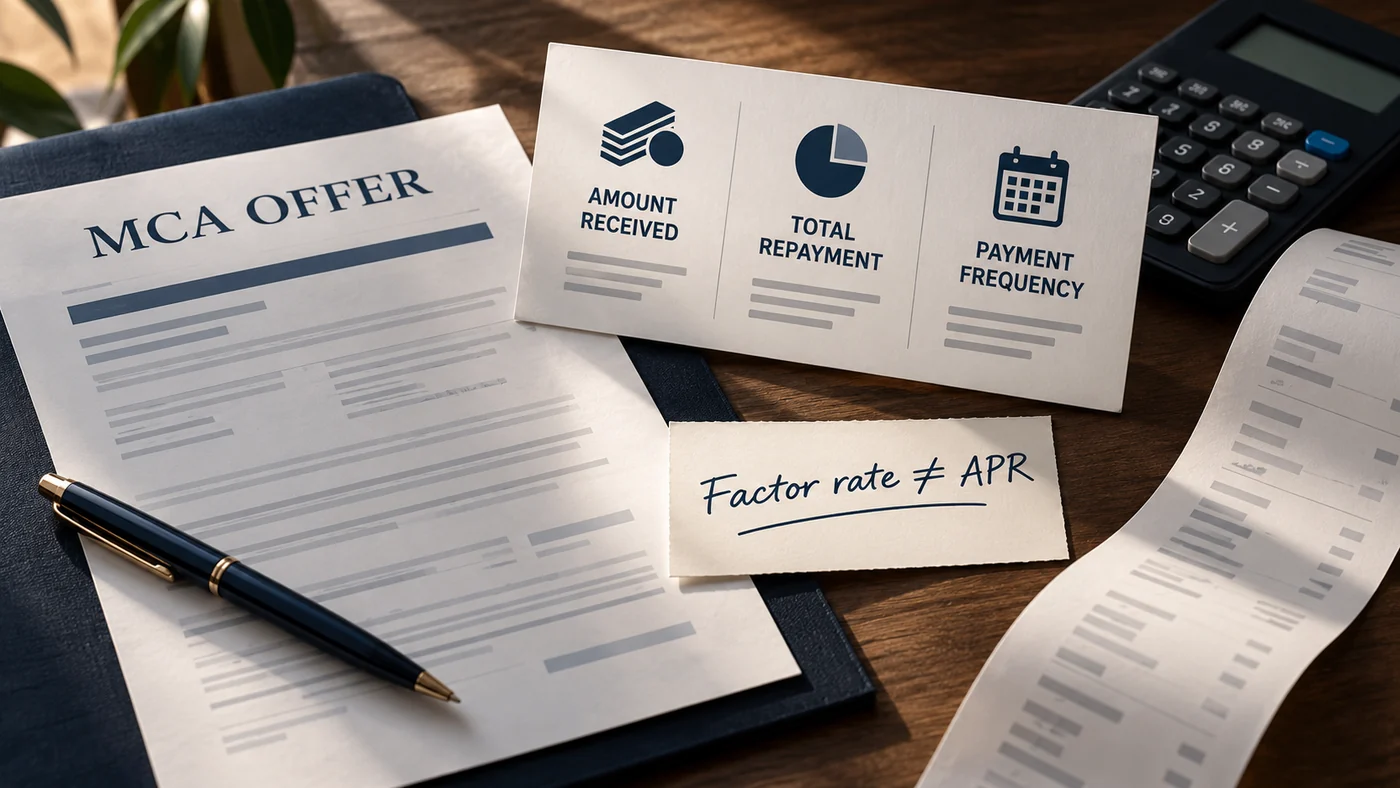
A merchant cash advance factor rate tells you the contractual multiplier. It does not, by itself, tell you the annual cost or whether the payment schedule fits your business.
A factor of 1.30 means $1.30 of purchased receivables for each $1 of the stated advance, before separately charged fees or adjustments. It is not a 1.30% interest rate, and it is not a 30% APR.
To understand an existing MCA, work through three separate numbers: the amount the agreement uses, the money actually provided for your benefit, and the total the funder expects to collect. Then place the payments on a calendar.
How to calculate a merchant cash advance factor rate
The basic calculation is straightforward:
Stated advance × factor = stated purchased amount
For a $20,000 advance at a 1.30 factor:
- $20,000 × 1.30 = $26,000 stated purchased amount.
- $26,000 − $20,000 = $6,000 difference before additional fees.
- $6,000 ÷ $20,000 = 30% of the stated advance.
The $26,000 is the total in this simplified example. The $6,000 is the amount above the stated advance. Calling both numbers “the cost” makes an agreement harder to compare.
If the contract gives the advance and purchased amount but no factor, divide the purchased amount by the advance: $26,000 ÷ $20,000 = 1.30. Check that both figures refer to the same transaction.
Start with net proceeds, not just the headline advance
Suppose the same agreement deducts a $1,000 fee before funding. If there are no other disbursements, $19,000 reaches the business, while the stated collection amount remains $26,000. The difference between what you receive and what is collected is now $7,000.
A renewal can be more complicated. Part of a new advance may pay an old balance instead of reaching your bank account. Separate these items:
- Cash deposited: the money available for current operations.
- Payoff made on your behalf: the amount actually applied to an existing obligation.
- Fees deducted or charged separately: amounts withheld and any later charges.
An old balance paid on your behalf is not the same thing as a fee. Avoid treating every dollar that did not reach your bank as a financing charge. Obtain the funding statement, old payoff confirmation and new agreement so the numbers can be reconciled.
Factor rate versus APR: why timing changes the answer
A factor expresses a multiplier. An annual percentage rate expresses an annualized financing cost under a defined calculation method. The latter requires more than subtracting 1 from the factor.
For the $20,000 / $26,000 example, a common shortcut is:
0.30 × 365 ÷ 180 = 60.83%
That is a simple annualization of a 30% cost over 180 days. It is not a reliable APR for an MCA collected through daily or weekly payments. It ignores when money is returned throughout that period. Merely adding fees to the shortcut does not fix that problem.
An APR calculation needs the amount financed, charges included under the applicable method, payment amounts and timing, and any assumptions needed for variable receipts. An estimate based on projected sales may differ from the result using actual collections.
All else equal, collecting the same dollar amount sooner increases the annualized financing cost. A “six-month” estimate therefore deserves scrutiny if the actual remittances would collect the purchased amount much sooner.
What a factor-rate calculator can—and cannot—show
A simple factor-rate calculator can accurately multiply $20,000 by 1.30. An APR calculator must do more. Before relying on its output, check whether it accepts net funding, fees, actual payment dates and the right payment frequency.
For example, dividing $26,000 by 180 gives $144.44 per payment only if there are 180 equal payments. It does not establish the correct daily debit for 180 calendar days when collections occur only on business days. Holidays, skipped days and adjustments can change the schedule.
If receipts fluctuate, examine how the agreement’s reconciliation process changes estimated withdrawals. A projected completion date should not quietly become a claim that collections can never be adjusted.
Use a calculator to check the arithmetic, then compare its assumptions with the signed documents. A calculator cannot decide whether the agreement is enforceable or whether a transaction is legally a loan.
Five contract terms that change the practical cost
- Fees: identify origination, broker, processing, servicing and other charges actually imposed. Do not count a fee twice if it is already included in another figure.
- Payment frequency: compare the weekly total across all existing MCAs, not one debit in isolation.
- Reconciliation: find the request procedure, supporting documents and adjustment terms.
- Early payoff: obtain a written payoff quote. A fixed purchased amount does not automatically shrink like interest on a declining loan balance; any discount or additional charge depends on the agreement.
- Default provisions: review alleged default charges, acceleration, guarantees and enforcement expenses separately from the scheduled cost.
Revenue history, industry, existing obligations, pricing practices and broker compensation can affect the offer. Credit requirements vary; do not assume that all funders require conventional credit approval or a particular minimum score.
A factor rate does not determine your legal rights
Calling a transaction a receivables purchase does not settle its legal classification. Courts may examine its substance, including who bears the risk that receipts decline. Our guide to when an MCA may be treated as a loan addresses that separate question.
It is also incorrect to say MCAs are free from all state or federal regulation. For example, New York’s commercial financing disclosure rules prescribe disclosures for covered transactions, including sales-based financing. Coverage and exemptions matter; disclosure requirements are not identical nationwide.
If the numbers in an existing MCA do not match the funding or collections, Business Debt Law Group can discuss the agreement, disputed charges and related MCA legal options. Consultations are always free. Any engagement and fees are separate.
Examples are simplified illustrations, not an APR quote or legal conclusion about a particular agreement. This article is general information, not individualized legal or financial advice. Outcomes depend on the documents, facts and applicable law.
Free MCA Loan Review or Case Evaluation
Have questions about your MCA agreements, payment pressure, or court papers? You do not need a lawsuit to request a free review.
Request My Free MCA Loan Review
Consultations are free; retained legal-service fees are separate. Contacting the firm does not create an attorney-client relationship or extend a deadline. No outcome is guaranteed.