
MCA Debt Settlement and Relief: How a Law Firm Can Help
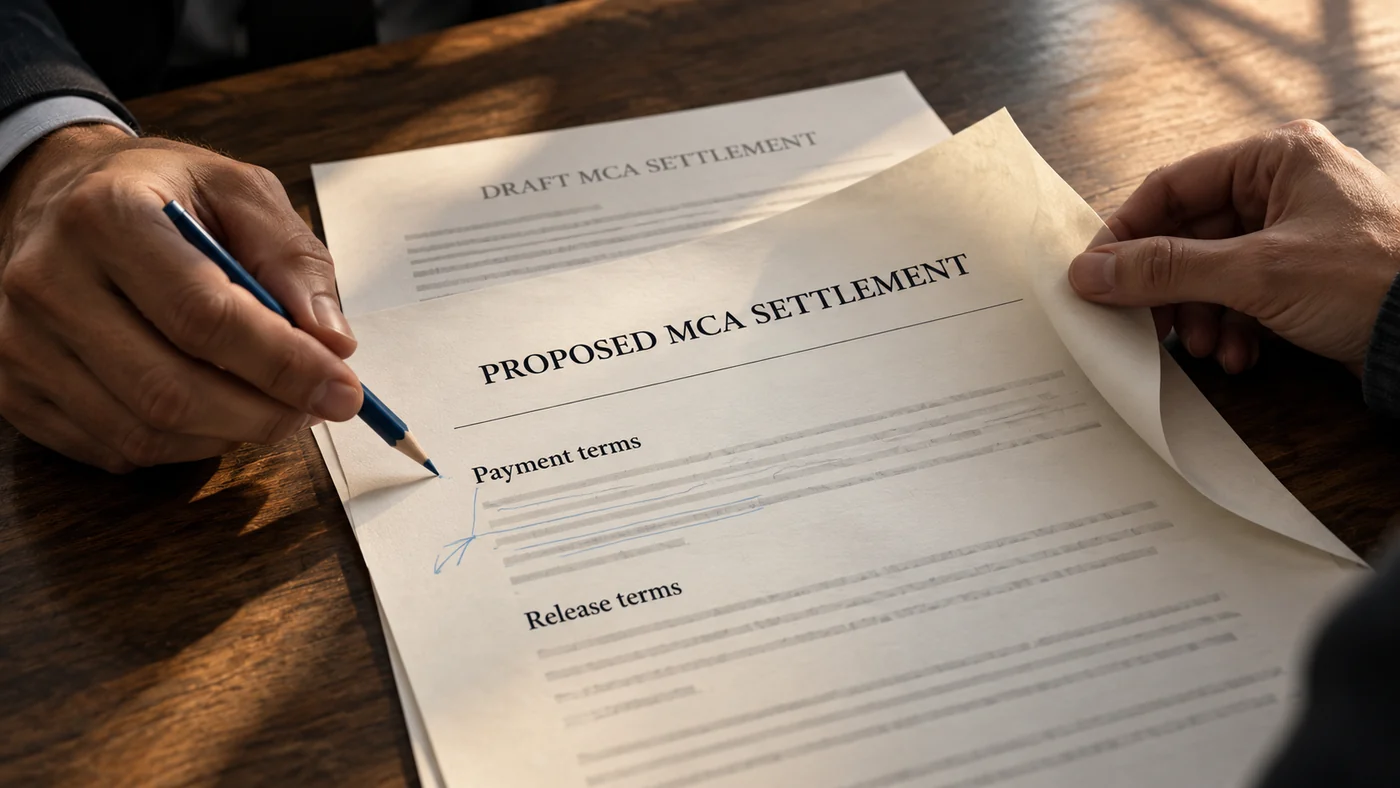
Compare your MCA relief options, understand the role of a law firm, and know what to confirm before signing a settlement.
MCA debt settlement is a negotiated agreement to resolve an existing merchant cash advance obligation. It may reduce the claimed balance, with payment through a lump sum or installments. MCA debt relief is the broader term people use for options such as settlement, payment restructuring, reconciliation, and legal defense.
A law firm can review the agreement, evaluate available defenses, and negotiate a resolution. Court representation depends on the engagement and the attorney’s authorization to appear, with local counsel coordinated when required.
What is possible depends on the agreements, payment history, revenue, alleged default, funder conduct, applicable law, and any pending enforcement action. No particular settlement, discount, or timeline can be promised.
What Is MCA Debt Settlement?
An MCA debt settlement generally starts with reviewing the transaction and then negotiating with the funder or other party authorized to resolve the claim. The discussions may address a lump-sum payoff, an installment arrangement, releases of claims, and steps needed to close out collection or litigation.
A settlement is not a new financing product, a reverse consolidation, or an automatic cancellation of the agreement. A lower periodic payment also does not necessarily mean a lower total obligation. The written terms determine what is resolved and what remains.
MCA Debt Relief Options Compared
These terms are sometimes used interchangeably, but they do different things. The appropriate option depends on your agreements, cash flow, and whether a lawsuit or enforcement action is underway.
| Option | What it does | What to review |
|---|---|---|
| Settlement | Resolves an existing obligation by agreement; it may involve a reduced balance paid in a lump sum or installments. | Payment terms, releases, guarantors, MCA UCC filings, and any pending lawsuit or judgment. |
| Reconciliation | May adjust remittances to actual receipts under the agreement’s reconciliation provisions. | Required records, the request procedure, timing, and how the funder has handled requests. |
| Restructuring | Changes payment amounts or timing without necessarily reducing the total obligation. | The new schedule, total amount payable, and whether existing default claims are resolved. |
| Reverse consolidation | Uses another financing arrangement to help make payments on existing MCAs. | The additional obligation, total cost, and whether existing funders are actually paid off. |
| Consolidation loan | Uses a new loan to pay off some or all existing MCAs. | Eligibility, which obligations are paid off, and the new payment schedule and total cost. |
| Lawsuit defense | Responds to court claims and raises available defenses; settlement may also be considered. | Response deadlines, evidence, guarantees, and the scope of legal representation. |
| Bankruptcy | Provides a court process that may pause many collection actions, subject to exceptions and court orders. | Eligibility, effects on the business and guarantors, and advice from bankruptcy counsel. |
For more detail, see our guides to MCA reconciliation clauses, MCA restructuring, reverse consolidation, and MCA consolidation loans and legal options.
Business Debt Law Group provides legal services; it does not provide or arrange financing. A new financing product can add another obligation, so review its agreement and total cost before relying on it for MCA debt relief. Use the MCA APR calculator to explore how fees and payment timing affect an estimated annualized cost.
Law Firm vs. MCA Debt Relief Company
Both may negotiate with MCA funders. The differences become especially important when a funder disputes a reconciliation request, invokes a guarantee, or files a lawsuit.
| Question | Law firm | Debt relief company that is not a law firm |
|---|---|---|
| Who negotiates? | Attorneys or staff working under attorney supervision, within the engagement’s scope. | Negotiators who may not be attorneys; ask who handles your accounts. |
| Who responds if you are sued? | An attorney can defend the business if retained for that work and authorized to appear in the court; local counsel may be required. | Nonlawyer negotiators cannot act as your attorneys in court. Any outside legal representation must be separately confirmed. |
| Who evaluates legal defenses? | Attorneys can advise on potential defenses involving reconciliation, guarantees, contract terms, and applicable law. | Nonlawyer negotiators do not replace an attorney’s legal advice. Ask whether an attorney is actually retained to represent you. |
| Are communications privileged? | Confidential communications for legal advice may be protected by attorney-client privilege, subject to applicable law, exceptions, and waiver. | Communications with nonlawyer negotiators generally do not carry attorney-client privilege. An attorney’s involvement does not automatically protect every communication. |
| How are fees and services defined? | Review the engagement agreement, including whether negotiation, litigation, and local counsel costs are included or separate. | Review when fees are earned, how payments are handled, cancellation terms, and any separate attorney charges. |
| Who reviews settlement paperwork? | Counsel can review payment terms, releases, MCA UCC termination provisions, dismissals, and guarantor obligations within the engagement. | Services vary. Confirm who evaluates the legal effect of the final documents. |
Some debt relief companies work with outside attorneys, and some businesses reach negotiated resolutions through them. Before enrolling anywhere, ask: Who will negotiate? Who will represent my business if it is sued? What services and fees are covered? Do not assume that enrolling in a program includes a court defense.
Should You Stop Paying Your MCAs to Settle?
Some debt relief programs recommend stopping MCA payments or blocking ACH debits to encourage negotiation. Many agreements treat stopped or blocked payments as a default. A funder may then demand the remaining claimed balance, add fees, send customer or processor notices, pursue a personal guarantor, or file a lawsuit. Whether those demands are enforceable requires review.
Changing payments can sometimes be part of a legal strategy, but the decision should follow an attorney’s review of the agreements, cash flow, and potential consequences. Do not assume that stopping payments will produce a settlement or prevent a lawsuit. A revenue decline may also make the agreement’s reconciliation procedure relevant.
See what a funder must prove in an MCA breach-of-contract lawsuit and what to review after an MCA default notice.
If a Debt Settlement Company Didn’t Work
If a debt relief program has stalled, a funder refuses to negotiate, or a lawsuit arrives while you are enrolled, start by identifying what remains unresolved.
- Check lawsuits and deadlines first. Settlement talks do not, by themselves, pause a court’s response deadline.
- Gather the program contract and payment records. Identify what you paid the company, what reached each funder, and what fees or balances remain.
- List every MCA and its status. Note which are settled, under negotiation, in alleged default, or in litigation.
- Collect written proof of completed settlements. Include the signed terms, payment confirmations, releases, and any required MCA UCC termination or court filings already completed or still due.
- Request a free MCA review or case evaluation. An attorney can review the open obligations, deadlines, and options before you commit to another arrangement.
For a closer look at fees, payment records, and changing providers, read what to check in an MCA debt relief program and what to do if it falls short.
When Might MCA Debt Settlement Be Considered?
A business owner may want legal advice when daily or weekly withdrawals interfere with payroll, vendors, taxes, inventory, or ordinary operations. The same applies when several MCA agreements create overlapping payment pressure or a funder declares default or threatens collection.
Settlement may also come up after a reconciliation request, customer notice, MCA UCC demand, bank restraint, confession-of-judgment issue, or lawsuit. The right next step depends on the documents and where the matter stands. You can request a review before missing a payment or being sued.
Prepare One Complete File for an MCA Settlement Review
A careful review starts with the complete file, not a promise about the outcome. Bring:
- The MCA agreement, addenda, guarantees, security agreements, and disclosures.
- The amount funded, repayment amount, withdrawals, payment history, and claimed balance.
- Revenue records and bank statements relevant to payment or reconciliation.
- Default notices, reconciliation requests, customer or processor notices, MCA UCC records, and communications.
- Complaints, judgments, confession-of-judgment documents, bank restraints, and other court papers.
- Every other MCA agreement when advances overlap, plus any existing debt relief program contract or settlement proposal.
This lets counsel compare the balance claimed with the payment history, identify disputed terms and deadlines, and consider a plan the business can realistically sustain.
What If an MCA Funder Has Declared Default?
A default notice does not answer every legal question by itself. The agreement, payment history, funder conduct, and applicable law all matter. A funder may pursue MCA collection activity, send notices to customers or processors, assert rights under an MCA UCC filing, or sue.
If court papers have been served, preserve them, note how and when they arrived, and obtain prompt review of the MCA lawsuit response deadline. Do not assume a conversation with the funder or a settlement company extends that deadline.
Review These Terms Before You Sign an MCA Settlement
The amount is only part of the deal. Review what must happen, who is responsible, and when each step is due:
- Who and what is released: Identify the MCA obligation, claims, business entities, and guarantors covered, anything that survives, and when each release takes effect.
- Payment amount and timing: Confirm every installment, due date, payment method, and fee against what the business can realistically pay.
- Conditions and default terms: Check any cure period and what a late or missed settlement payment could trigger, including a claim for a larger balance.
- When withdrawals change or stop: State whether existing MCA ACH debits will end or be replaced by settlement payments, the effective date, and who must implement the change. Keep written confirmation.
- Pending litigation or judgments: Identify any required dismissal, satisfaction of judgment, or other filing; who completes it; and the deadline or payment condition that triggers it.
- MCA UCC filings and third-party notices: Review the MCA UCC termination and release terms, who handles any required filing, and when customer or processor notices must be withdrawn or updated.
- Tax questions: Ask a tax professional whether a reduced payoff has tax consequences for the business or owners.
- Other continuing obligations: Review confidentiality, restrictions, and any commitments that remain after payment.
Signing is not the same as completing every settlement step. Some releases or filings may become due only after the final payment. Keep the signed agreement, proof of payment, and confirmation that each required follow-up step was completed.
MCA Debt Settlement FAQs
How much will an MCA settle for?
There is no standard percentage. It depends on the documents, payment history, available defenses, the funder’s position, and what the business can realistically pay. Our MCA settlement results show past examples. Past results do not guarantee a similar outcome.
Can I settle multiple MCAs at once?
Each funder generally requires a separate agreement. Reviewing all advances together helps identify competing demands and a combined payment schedule the business can afford. One funder’s settlement does not automatically resolve another funder’s claims.
Is MCA debt relief legitimate?
Legitimate options exist, including negotiated settlements, appropriate payment adjustments, and legal defense. But the phrase “MCA debt relief” does not establish a provider’s qualifications or guarantee results. Check who will perform the work, the written fees and services, and who will respond if a funder sues.
Will a settlement stop the daily withdrawals?
Do not assume that signing alone stops them. Confirm in writing whether the existing debits will end or be replaced by settlement payments, when that change takes effect, and who will carry it out. Any separate court order or legal restriction also needs to be considered.
Can I settle after I have been sued?
Settlement may still be possible after a lawsuit is filed. Negotiations do not, by themselves, extend the response deadline. Counsel should address the lawsuit and any required dismissal or judgment paperwork along with the settlement terms.
Is the MCA review free?
Yes. All consultations are free, including the MCA review or case evaluation. You do not need a lawsuit to request help. Fees for any retained legal services are separate and should be addressed in the engagement agreement.
Request a Free MCA Review or Case Evaluation
Juggling multiple MCAs, reviewing a settlement offer, or dealing with a debt relief program that has stalled? Bring the agreements, payment history, claimed balances, and any court papers. Business Debt Law Group can review your circumstances and discuss potential next steps.
Speak with a merchant cash advance attorney. Call 888.407.7460 or request your free MCA review. No lawsuit is required to get help.
This article provides general information, not legal advice for a particular matter. Available options depend on the agreements, facts, applicable law, and procedural status. Contacting the firm does not create an attorney-client relationship, stop collection activity, or extend a deadline. Consultations are free; retained legal-service fees are separate. No settlement, savings, or outcome is guaranteed.