
Merchant Cash Advance Regulation: State Laws and Business Protections
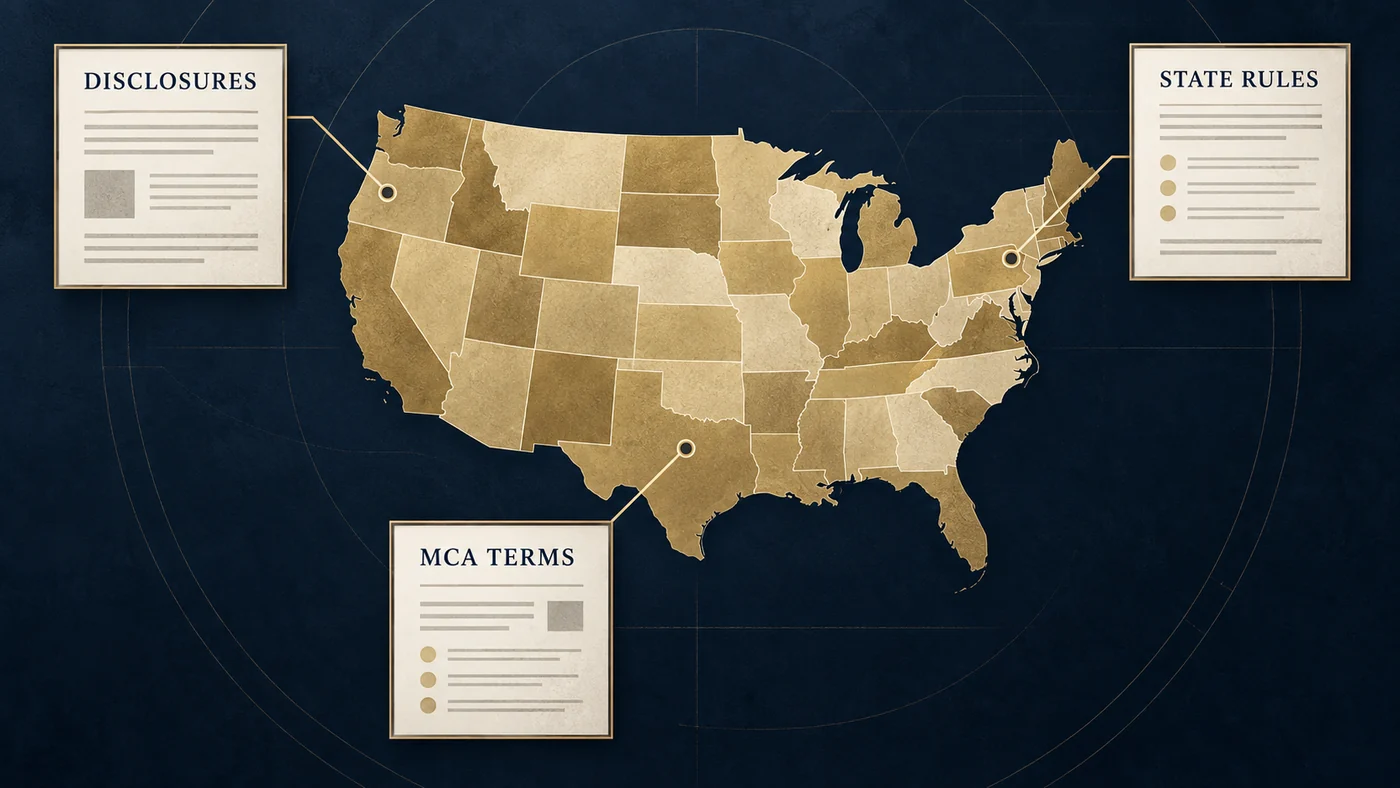
Merchant cash advance regulation includes state disclosure requirements, provider and broker registration in certain states, and enforcement against unlawful business practices. MCAs are not outside the law. The protections that apply depend on the transaction, the business’s location, the provider’s activities, and the governing law.
For a business owner, the useful questions are specific: What should the provider have disclosed? Does it need a registration? Do the withdrawals match the agreement? And where can you turn if something is wrong?
This guide explains the main types of oversight and selected state examples. For a closer look at contract enforceability and whether an arrangement may be treated as a loan, see Are Merchant Cash Advances Legal?
Are Merchant Cash Advances Regulated?
Yes, although the rules are not uniform across the country. A provider may face disclosure duties under one state’s commercial-financing law, registration duties under another state’s sales-based-financing law, and restrictions on deceptive conduct regardless of what its agreement is called.
Disclosures
Covered providers must explain specified costs and payment terms. The required information, timing, and format vary by state.
Registration
Some states require covered providers or brokers to register. Check the entity, activity, exemptions, and applicable deadline.
Conduct
Marketing, withdrawals, servicing, and collection practices can raise separate legal issues beyond the contract’s price.
These categories answer different questions. A disclosure requirement does not necessarily impose a price cap. A registration does not establish that every contract term is enforceable. And describing an agreement as a purchase of receivables does not excuse unlawful conduct.
Merchant Cash Advance Regulation News and Updates
Regulatory sources checked September 30, 2026. The developments below are dated examples, not a complete list of state requirements.
Texas: registration rollout in 2026
The Texas Office of Consumer Credit Commissioner lists its commercial sales-based financing rules as effective July 9, 2026, with registration required by December 31, 2026. Its application guidance says businesses can apply through NMLS beginning September 1, 2026. Those are different milestones: the rule’s effective date and the registration deadline should not be treated as the same date. See the OCCC’s adopted rules and dates and registration guidance.
California: an express invitation to report MCA concerns
In its April 2025 small-business advisory, California’s Department of Financial Protection and Innovation invited complaints about merchant cash advances. The agency explains that commercial-financing disclosure rules took effect in December 2022 and protections against unfair, deceptive, or abusive practices took effect in October 2023. Read the DFPI’s MCA advisory.
What this means for an existing agreement: A new rule, a proposed bill, and a final enforcement order are not interchangeable. Check the effective date, covered transactions, exemptions, and available remedies before assuming a headline changes your obligations.
Who Regulates Merchant Cash Advances at the Federal Level?
The Federal Trade Commission has brought enforcement actions involving deceptive MCA marketing and collection practices. For example, a 2022 FTC action involving Richmond Capital Group resulted in an industry ban against an owner and an order to pay more than $2.7 million for refunds. That is a specific enforcement result, not a finding that every MCA provider acts unlawfully.
Federal consumer-credit disclosure rules are a different issue. Regulation Z, which implements the Truth in Lending Act, generally exempts credit primarily for business or commercial purposes. It would therefore be misleading to promise that a business MCA receives the same federal disclosure protections as a consumer credit card.
That exemption does not mean the industry is free from federal oversight. It also does not eliminate disclosure duties imposed independently by state law.
Merchant Cash Advance Regulation by State
States use different definitions and coverage thresholds. These examples show the types of rules a business owner may encounter; they are not a 50-state survey or a determination that a particular transaction is covered.
| State | What the rules address | What to check |
|---|---|---|
| California | Commercial-financing disclosures and protections against unfair, deceptive, or abusive practices. DFPI overview. | Whether the offer and provider conduct fall within the applicable California rules. |
| New York | Covered sales-based offers require disclosures including a finance charge, estimated APR, payment information, and early-payoff terms. Financial Services Law § 803. | Whether the required disclosure accompanied the specific offer, and what assumptions underlie the estimates. |
| Virginia | Registration for covered providers and brokers, offer disclosures, and limits on certain contract provisions, including confessions of judgment. Sales-Based Financing Providers law. | Coverage, exemptions, registration status, disclosure documents, and enforcement provisions. |
| Florida | Covered commercial-financing transactions require written disclosures at or before consummation, including funding, dollar cost, payment terms, and prepayment costs or discounts. Florida Statutes § 559.9613. | Whether the disclosed cash disbursement and payment terms match the transaction actually completed. |
| Texas | A commercial sales-based financing framework under Chapter 398, with provider and broker registration administered by OCCC. OCCC overview. | The covered activity, exemptions, and applicable requirements, including the December 31, 2026 registration deadline noted above. |
Do not stop at the state named in a contract’s choice-of-law clause. A lawyer should also examine where the recipient does business and each statute’s geographic scope, transaction size, exclusions, and effective date. More than one legal framework may be relevant.
The absence of your state from this table does not mean that an MCA is unregulated there. Likewise, a state’s disclosure law should not be read as adopting every protection listed for another state.
What to Look for in an MCA Disclosure
Use the following questions to compare the offer, agreement, and actual funding. This is a review checklist; not every item is a mandatory disclosure in every state.
- How much cash reaches the business? Separate the stated advance from fees, payments to prior funders, and other deductions. A headline funding amount may differ substantially from the deposit.
- What is the total dollar obligation? Identify the purchased amount or total repayment figure, finance charge, and charges triggered by returned payments, default, or collection.
- How are payments calculated? Determine the percentage of receipts, estimated daily or weekly withdrawals, and assumptions used for any projected duration.
- How can payments change? Read the reconciliation process, required documents, request deadlines, and how an adjustment affects future withdrawals or past overcollections.
- What cost measures are provided? Where an estimated APR is required, review it alongside the assumptions. A factor rate is not an annual percentage rate.
- What happens at early payoff? Ask whether paying sooner reduces the amount owed, leaves the full purchased amount payable, or triggers another charge. Obtain the payoff calculation in writing.
- Who else is obligated or paid? Identify the broker, any broker fee, security interests, personal guarantees, and the conduct that triggers liability.
Example: An offer may describe $80,000 in funding, but if $5,000 in fees and $25,000 owed to another funder are deducted, only $50,000 reaches the business. Compare the new obligation and payment burden against that actual cash benefit. The example illustrates the arithmetic, not a legal conclusion about the charges.
Do MCA Companies Need a License or Registration?
There is no single answer that applies to every company in every state. Virginia’s sales-based financing law and Texas’s registration framework illustrate why the provider’s and broker’s roles both matter. A financing license, sales-based financing registration, and ordinary business registration are different records.
Start with the exact legal names in the agreement and broker documents. Check the relevant regulator’s instructions and public records for the specific activity, state, and time period. If a search produces no match, ask about alternate business names, coverage, and exemptions before concluding that the company is operating unlawfully.
Registration also is not a recommendation that the financing is affordable. Review the economics and contract terms even when the company’s required registration is active.
Does a Regulatory Violation Cancel the MCA?
Do not assume that a missing disclosure, registration issue, or complaint automatically erases the balance. The consequence depends on the specific law, the facts, who can enforce it, and what remedy the law authorizes. Regulatory penalties and a business owner’s private contract remedies are separate questions.
Some laws expressly affect contract provisions. For example, Virginia’s sales-based financing statute states that a provision that does not comply with its chapter is unenforceable. That is a state-specific rule, not a nationwide rule that every paperwork defect voids an entire agreement.
A review may also consider whether the arrangement is legally a loan, whether a guarantee was triggered, and whether collections complied with the agreement. Our MCA legality guide explains those distinctions. A suspected violation alone is not a sound basis for deciding to stop payments or ignore a demand.
How to Report a Merchant Cash Advance Concern
Preserve the records before they become harder to retrieve: every agreement and amendment, the offer and disclosures, broker messages, proof of funding, bank statements, payment history, reconciliation requests, payoff statements, and collection or court papers. Create a short timeline and identify the exact amount or statement you dispute.
- State financial regulator or attorney general: Confirm which office handles commercial-financing concerns in the relevant state. California’s DFPI specifically invites MCA complaints through its small-business advisory. The USA.gov state-office directory can help locate an office; confirm that it accepts your type of business complaint.
- Federal Trade Commission: Suspected fraud or deceptive business practices can be reported at ReportFraud.ftc.gov. The FTC uses reports to identify patterns and support enforcement; it does not resolve individual reports.
- Your attorney: A regulator complaint does not replace advice about your contract, potential claims, negotiation, or defense in court.
If a lawsuit, bank restraint, or response deadline is already involved: Seek review promptly. Filing a complaint does not itself pause collection or a court deadline. Bring the actual papers, not just a summary of the provider’s demands. See our MCA lawsuit guide.
Connect the Rules to Your Business’s Next Step
Knowing that a regulation exists is only the beginning. The useful next step is to match the agreement, cash flow, withdrawal history, and provider conduct to the requirements that actually apply.
If revenue has fallen, review your MCA reconciliation terms. If the payment burden is no longer manageable, compare restructuring and settlement considerations in our MCA debt options resource.
Have your MCA documents reviewed
Business Debt Law Group offers a complimentary initial review to discuss your agreement, payment concerns, and possible legal options. The firm provides legal services and does not provide or arrange financing.
This article provides general information, not advice about a particular agreement. Laws, exemptions, and remedies vary by jurisdiction and can change. Linked official sources provide additional detail.
Free MCA Loan Review or Case Evaluation
Have questions about your MCA agreements, payment pressure, or court papers? You do not need a lawsuit to request a free review.
Request My Free MCA Loan Review
Consultations are free; retained legal-service fees are separate. Contacting the firm does not create an attorney-client relationship or extend a deadline. No outcome is guaranteed.