
1 Stop Cap MCA lawsuit or frozen business receivables?

When receivables are held and a settlement offer arrives, the monthly payment is only one part of the decision. A 1 Stop Cap agreement may also ask you to acknowledge collection rights or give up claims and defenses.
Free MCA review or case evaluation.
No lawsuit is required to ask for help.


The 1 Stop Cap file
The redacted document in BDLG’s library identifies 1 STOP CAP INC. doing business as 1 STOP CAP. It describes an existing secured agreement, held receivables and a proposed settlement. Match that complete name to your contract and notices before relying on information about a similarly named financing company.
A publicly filed agreement under the same company name is titled a receivables purchase agreement. The company’s current website also uses working-capital loan terminology. Those labels should not replace review of your own signed transaction: identify the purchase provisions, reconciliation rights, guaranty and the actual collection activity.
This guide is for merchants dealing with an existing MCA dispute. BDLG does not arrange new funding. Bring both the initial financing documents and any later settlement proposal so that a proposed release can be evaluated in the context of the rights it would affect.
Sources: 1 Stop Cap’s website · Filed receivables agreement (public exhibit)
- Name shown in the excerpt
- 1 STOP CAP INC. d/b/a 1 STOP CAP
- Existing collection issue
- Held business receivables
- Beyond the payment amount
- Acknowledgments and waivers in the proposed settlement
- Independent legal representation
- Business Debt Law Group is not affiliated with, endorsed by, or acting for 1 Stop Cap.
A payment proposal that also addresses disputed rights
The excerpt states a $21,926.36 balance and describes $14,000 settlement terms payable at $1,400 monthly until paid. It also discusses held receivables, consent to the claimed collection activity, and a broad waiver of claims and defenses. The visible page does not establish the treatment or release of every held dollar or the later performance of the agreement.
See more MCA settlement examples ↗
Partial, redacted excerpt from one matter. Other pages, amendments and later events may affect these terms. This discussion does not summarize the complete agreement or case. Acceptance, completed payment, releases and the final outcome require verification from the complete records. This is not a standard offer or promised result. Past results do not guarantee a similar outcome.
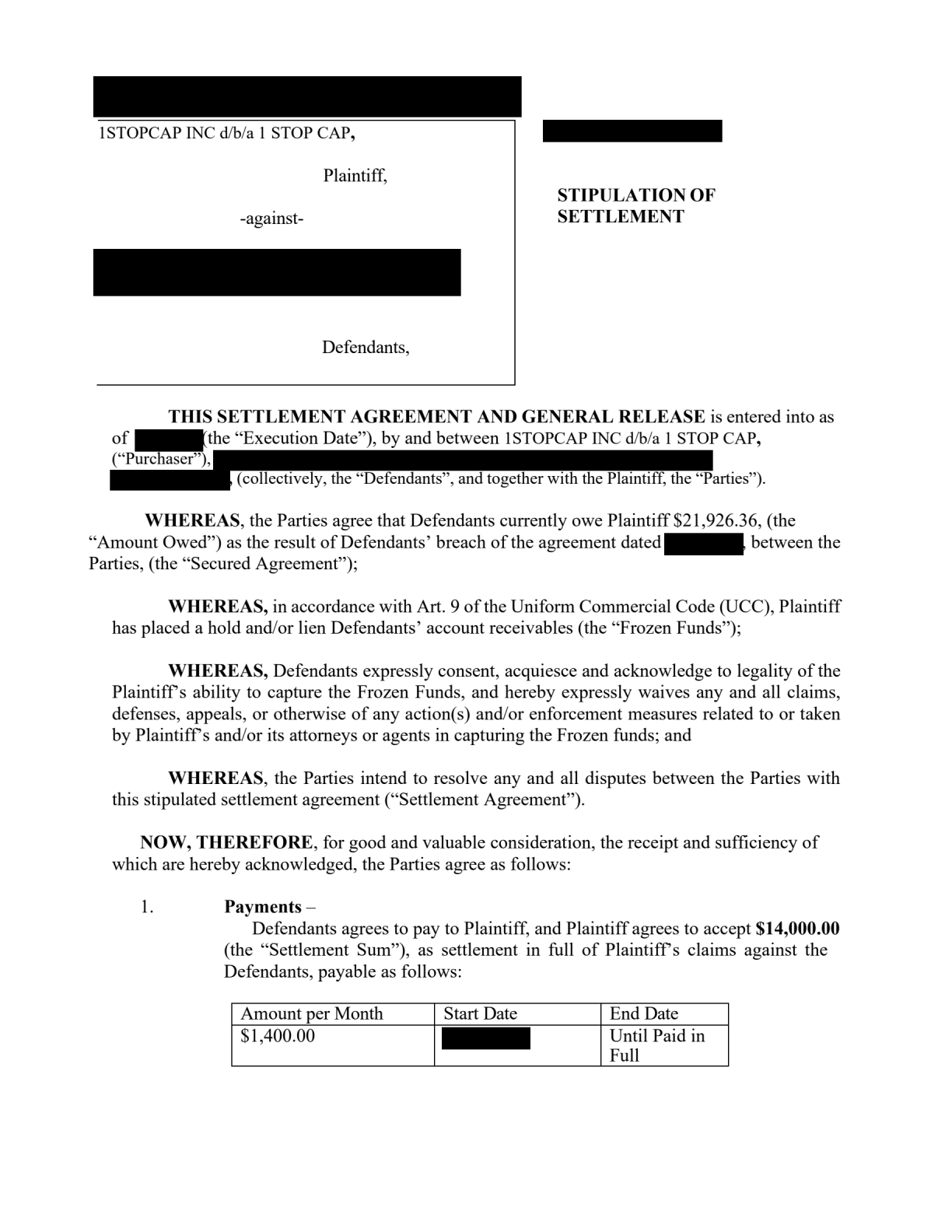
Read what you would give up alongside what you would pay
Ask for a separate accounting of money held, money already transferred and payments merely scheduled. A restrained balance and a credited payment are not the same event. Before agreeing to a remaining balance, determine what evidence shows where each amount sits and how the complete settlement says it will be applied.
Mark any provision that admits the legality of earlier collection steps, accepts jurisdiction or releases defenses. Those terms may affect arguments beyond the monthly schedule. Counsel can compare the language with your actual notices and procedural history; a favorable payment amount alone does not answer whether the full agreement is appropriate.
If a processor or customer is withholding receivables, retain the exact notice and its delivery information. Identify the instruction needed to change the hold and who must send it. Do not assume that signing a settlement, or making its first payment, automatically causes every third party to release funds.
Where does your 1 Stop Cap matter stand?
MCA payments are too much
Compare the proposed monthly amount with the cash you can actually use while funds remain held.
Receivables or accounts are affected
Separate a hold, a transfer and a credit in the ledger. Bring communications from the bank, processor or customer that controls the funds.
Court papers have arrived
Review any existing judgment or pending action before accepting admissions or waivers in a settlement.
Four practical first steps.
- Check for a court deadline.If you received court papers, identify where the case is filed and when a response is due. Settlement discussions do not automatically extend a deadline.
- Put the records in one place.Collect the agreement, payment history, bank statements, and every notice. Preserve emails and texts, including any proposed settlement terms.
- Review a proposed change before signing.A new agreement, acknowledgment, release, or guarantee can affect your rights and obligations. Have its terms reviewed in context.
- Discuss a plan for your actual situation.Ask which legal or negotiation options fit the documents, cash flow, and litigation status—and what representation would cost.
1 Stop Cap MCA questions, answered.
Does the public example prove that held funds were released?
No. The excerpt discusses held receivables and settlement terms. Release instructions, transfer records and the complete file are needed to establish what happened.
Should I sign just because the monthly payment is lower?
Review the entire proposal first. Its admissions, releases, default terms and treatment of held funds can be as important as the payment amount.
Does a website’s use of the word loan decide what my agreement is?
No. Legal characterization depends on the agreement, its operation, the facts and applicable law. Bring the actual signed documents.
Can BDLG review this before a lawsuit is filed?
Yes. You can request a free MCA review for payment pressure or collection notices as well as an existing case.
What does the free MCA review cover?
The initial consultation can address your MCA agreement, payment pressure, collection communications or case status. Consultations are free. Any retained legal-service fees are separate and addressed in the engagement terms.
Let’s review your 1 Stop Cap MCA.
Tell us about the payment demand, proposed agreement or court papers you need help understanding.
General information, not legal advice. Options depend on the agreements, facts, applicable law, and procedural history. No result is guaranteed. Contacting the firm does not create an attorney-client relationship or extend a deadline. Business Debt Law Group provides legal services; it does not provide or arrange financing.