
Blackbridge Investment Group MCA lawsuit or a biweekly settlement proposal?

A revenue-based funding agreement and a later settlement can use very different payment rules. For a Blackbridge matter, identify which document governs the demand you are facing today.
Free MCA review or case evaluation.
No lawsuit is required to ask for help.


The Blackbridge file
Blackbridge Investment Group describes itself on its website as a revenue-based direct funder and fintech company, using the BIG branding. Its explanation emphasizes payments connected to business revenue. That public description is useful background, but the signed contract and actual payment history control the questions for an individual review.
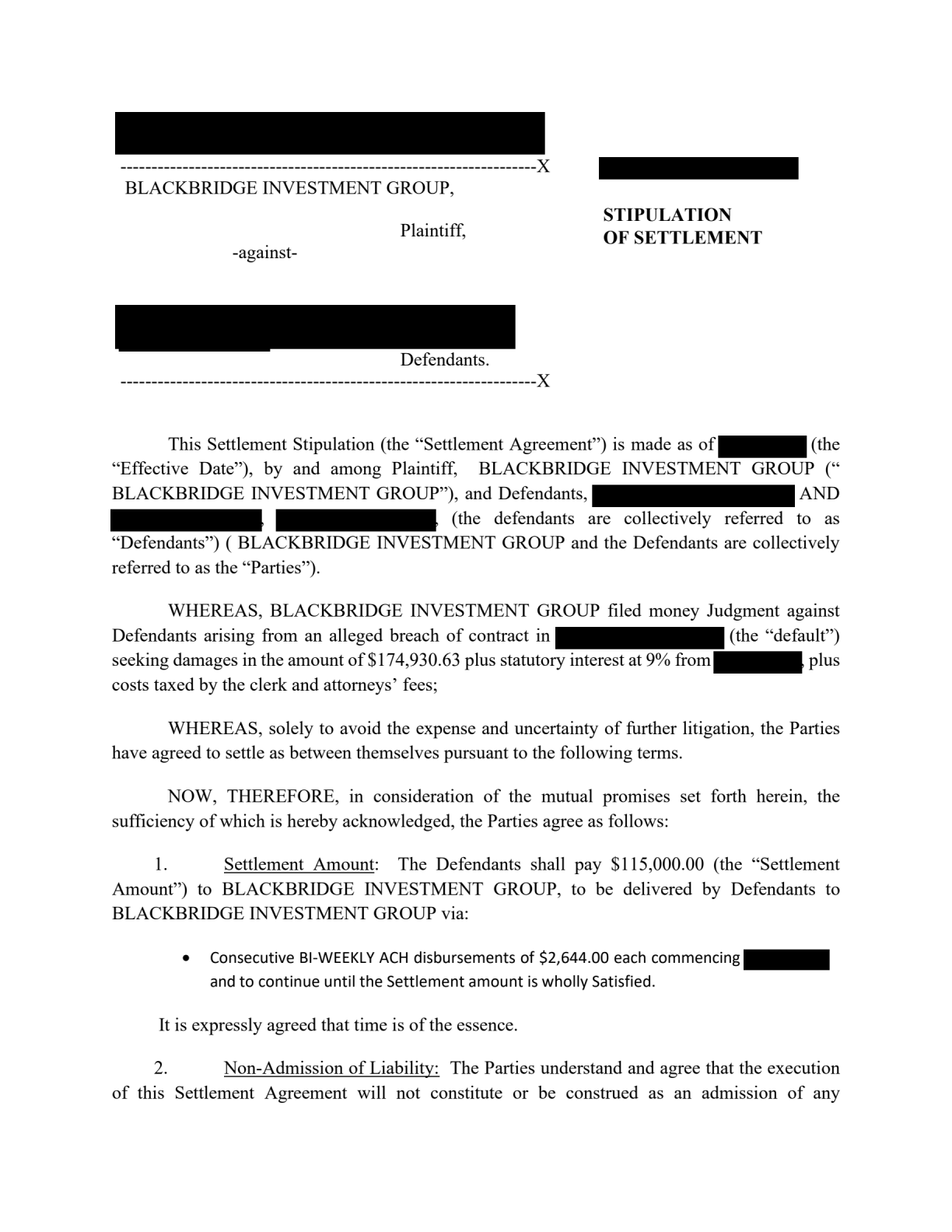
The redacted BDLG example uses the name Blackbridge Investment Group and describes a settlement after a money judgment. Public court exhibits also show the longer name Blackbridge Investment Group Fund I LLC. Match the complete entity and any assignments in your records; do not treat a shortened brand reference as proof of every legal relationship.
This page addresses MCA payment and litigation issues. It does not evaluate Blackbridge as an investment or recommend applying for funding.
Sources: Blackbridge: About Us · Publicly filed merchant agreement
- Public branding
- Blackbridge Investment Group / BIG
- Company’s stated model
- Revenue-based direct funding
- Example’s later payment method
- Biweekly ACH settlement installments
- Independent legal representation
- Business Debt Law Group is not affiliated with, endorsed by, or acting for Blackbridge Investment Group.
A later agreement with fixed biweekly ACH terms
The excerpt refers to a money judgment and a $174,930.63 claimed amount plus interest, costs and attorneys’ fees. It describes a $115,000 settlement with $2,644 biweekly ACH disbursements until satisfied. The visible page also begins a non-admission provision. The full agreement is required to determine all conditions, credits and closing obligations.
See more MCA settlement examples ↗
Partial, redacted excerpt from one matter. Other pages, amendments and later events may affect these terms. This discussion does not summarize the complete agreement or case. Acceptance, completed payment, releases and the final outcome require verification from the complete records. This is not a standard offer or promised result. Past results do not guarantee a similar outcome.
Check whether the payment rules changed when the dispute was settled
Place the original funding agreement beside the settlement proposal. Identify the revenue percentage, estimated withdrawal and reconciliation process in the original, then compare the new installment, frequency and default conditions. Do not assume an original adjustment provision carries into a later fixed schedule.
Biweekly and twice-monthly schedules are different. For an every-two-weeks schedule, map the actual dates across payroll, rent and other MCA withdrawals; some months can contain three debits. If the contract uses the term biweekly without clear dates, seek clarification rather than guessing its meaning.
Because the example refers to a judgment, the payment plan should be reviewed alongside the docket and any enforcement measures. Confirm which party supplies the satisfaction or other closing filing after performance and how already collected amounts are credited. A settlement figure alone does not establish that the judgment has been removed.
Where does your Blackbridge matter stand?
MCA payments are too much
Review the actual debit calendar and any reconciliation requests, not just an average monthly payment.
Receivables or accounts are affected
Gather the underlying notice and identify whether the claimed authority comes from the agreement or a judgment.
Court papers have arrived
Compare the complete entity name in the lawsuit, contract and proposed settlement, then check the current docket status.
Four practical first steps.
- Check for a court deadline.If you received court papers, identify where the case is filed and when a response is due. Settlement discussions do not automatically extend a deadline.
- Put the records in one place.Collect the agreement, payment history, bank statements, and every notice. Preserve emails and texts, including any proposed settlement terms.
- Review a proposed change before signing.A new agreement, acknowledgment, release, or guarantee can affect your rights and obligations. Have its terms reviewed in context.
- Discuss a plan for your actual situation.Ask which legal or negotiation options fit the documents, cash flow, and litigation status—and what representation would cost.
Blackbridge MCA questions, answered.
Are biweekly payments the same as two payments per month?
Not ordinarily. Every-two-weeks payments follow a different calendar. Confirm the exact dates and meaning stated in your agreement.
Does revenue-based marketing mean my settlement payment adjusts automatically?
No. Review the settlement’s own terms. An adjustment mechanism in an original funding agreement should not be assumed to apply to a later settlement.
Does the public settlement prove either side admitted wrongdoing?
No. The excerpt begins a non-admission provision, and settlement by itself does not prove wrongdoing. The complete document is needed for its full language.
Can BDLG help before I agree to a payment plan?
Yes. A free MCA review can address the proposed terms, current case stage and documents needed to evaluate your options.
What does the free MCA review cover?
The initial consultation can address your MCA agreement, payment pressure, collection communications or case status. Consultations are free. Any retained legal-service fees are separate and addressed in the engagement terms.
Let’s review your Blackbridge MCA.
Tell us about the payment demand, proposed agreement or court papers you need help understanding.
General information, not legal advice. Options depend on the agreements, facts, applicable law, and procedural history. No result is guaranteed. Contacting the firm does not create an attorney-client relationship or extend a deadline. Business Debt Law Group provides legal services; it does not provide or arrange financing.