
Rival Funding MCA lawsuit or a missed settlement installment?

A reduced monthly schedule can carry a much larger default exposure. Review the due date, notice language and credits before relying on the settlement balance alone.
Free MCA review or case evaluation.
No lawsuit is required to ask for help.


The Rival file
Rival Funding’s own FAQ describes its business cash advance as a purchase of future receivables and distinguishes the factor-based payback amount from the funded amount. That marketing description does not determine the legal treatment of every agreement; the actual terms and circumstances require review.
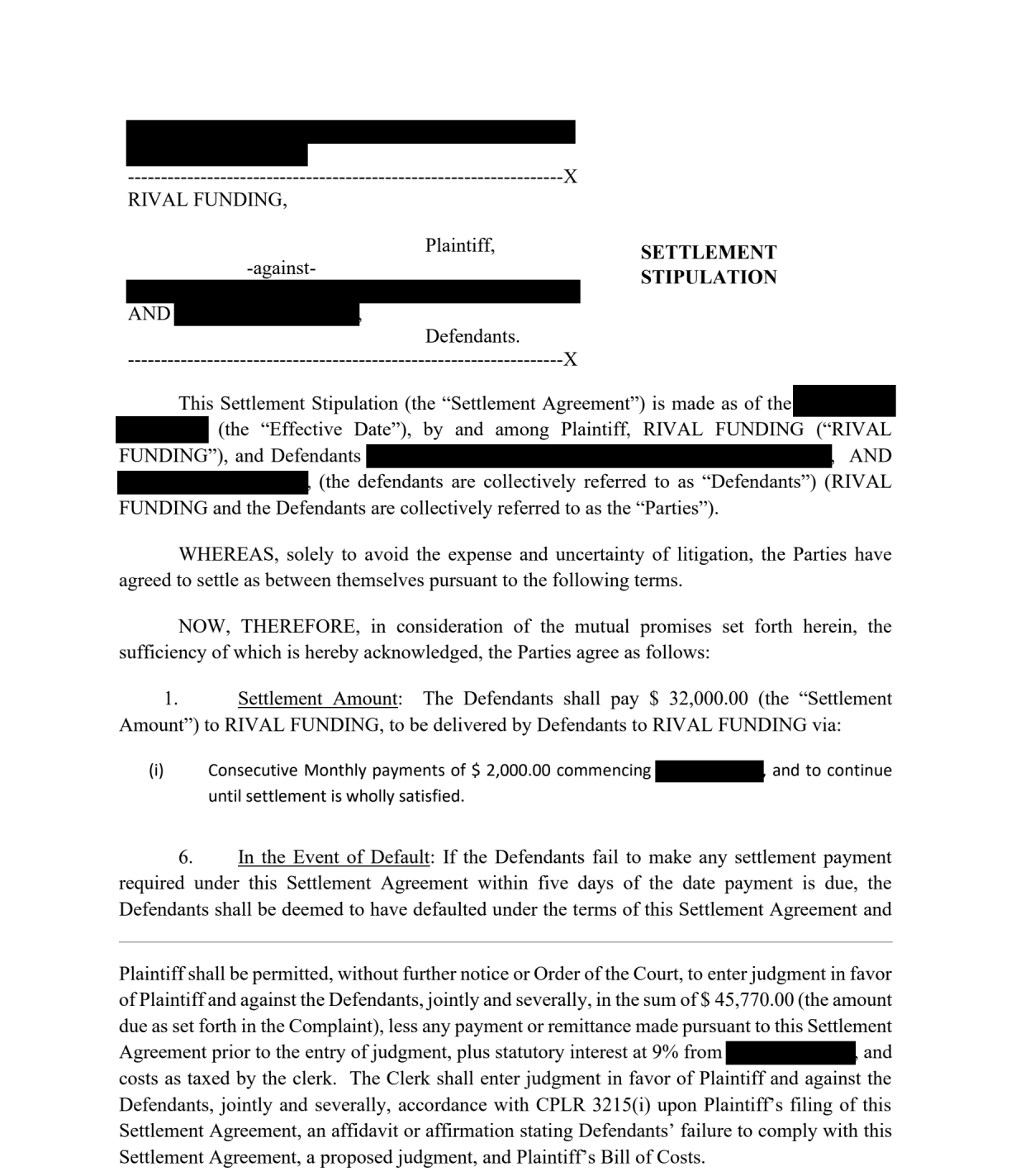
The Rival Funding stipulation in BDLG’s library describes $32,000 payable in consecutive monthly installments of $2,000. A separate default provision refers to a $45,770 complaint amount, prior-payment credits, interest and costs.
The excerpt moves between different numbered clauses. It is not the complete agreement, and it does not establish that a default or judgment actually occurred.
- Name in the stipulation
- Rival Funding
- Regular schedule described
- $2,000 monthly toward $32,000
- Separate default figure
- $45,770 before stated adjustments
- Independent legal representation
- Business Debt Law Group is not affiliated with, endorsed by, or acting for Rival Funding.
The scheduled balance and default calculation are different
The excerpt states that failing to make a required payment within five days of its due date is a settlement default. It then describes judgment language based on $45,770, less settlement payments made before judgment, plus stated interest and costs. The text says no further notice is required under that provision. Enforceability and the applicable court procedure must be assessed from the complete file.
See more MCA settlement examples ↗
Partial, redacted excerpt from one matter. Other pages, amendments and later events may affect these terms. This discussion does not summarize the complete agreement or case. Acceptance, completed payment, releases and the final outcome require verification from the complete records. This is not a standard offer or promised result. Past results do not guarantee a similar outcome.
Review a late payment before it becomes a balance dispute
Do not assume every MCA settlement requires a new warning email before default. This Rival excerpt measures five days from the payment’s due date. Other agreements use receipt of a notice or business-day periods. Your own signed language determines which timing question counsel must examine.
If a payment is disputed, preserve its initiation date, receipt date and the ledger entry showing credit. Ask for an itemized calculation distinguishing the settlement balance from the amount claimed after default. A restored claim should not be reviewed without accounting for the credits the agreement specifies.
Bring any proposed judgment, supporting affidavit and court notice to counsel promptly. The stipulation refers to a New York judgment procedure, but the excerpt alone does not establish that the procedure’s requirements were met or that a judgment was entered.
Where does your Rival matter stand?
MCA payments are too much
Review a possible payment adjustment before another installment is missed, with realistic cash-flow records.
Receivables or accounts are affected
Preserve collection communications and ask which signed terms or court papers support the current demand.
Court papers have arrived
Have counsel examine the actual judgment request and payment credits, not only the creditor’s summary balance.
Four practical first steps.
- Check for a court deadline.If you received court papers, identify where the case is filed and when a response is due. Settlement discussions do not automatically extend a deadline.
- Put the records in one place.Collect the agreement, payment history, bank statements, and every notice. Preserve emails and texts, including any proposed settlement terms.
- Review a proposed change before signing.A new agreement, acknowledgment, release, or guarantee can affect your rights and obligations. Have its terms reviewed in context.
- Discuss a plan for your actual situation.Ask which legal or negotiation options fit the documents, cash flow, and litigation status—and what representation would cost.
Rival MCA questions, answered.
Does the excerpt require a new default notice?
The visible provision refers to five days after the payment due date and says no further notice is required for the described remedy. Review the complete agreement and applicable procedure.
Would the default amount simply be the unpaid $32,000?
The excerpt uses a different calculation tied to $45,770, prior payments, interest and costs. That calculation needs an account-specific review.
Do prior settlement payments count?
The visible default clause calls for a deduction for payments or remittances made under the settlement before judgment. Verify the actual credited amounts.
Does the clause prove Rival obtained a judgment?
No. A proposed contractual remedy and an entered court judgment are different records.
What does the free MCA review cover?
The initial consultation can address your MCA agreement, payment pressure, collection communications or case status. Consultations are free. Any retained legal-service fees are separate and addressed in the engagement terms.
Let’s review your Rival MCA.
Tell us about the payment demand, proposed agreement or court papers you need help understanding.
General information, not legal advice. Options depend on the agreements, facts, applicable law, and procedural history. No result is guaranteed. Contacting the firm does not create an attorney-client relationship or extend a deadline. Business Debt Law Group provides legal services; it does not provide or arrange financing.