
Divine Funding MCA lawsuit or a settlement without admitting liability?

A negotiated payment arrangement and an admission of wrongdoing are different questions. Read the non-admission clause with every other obligation in the agreement.
Free MCA review or case evaluation.
No lawsuit is required to ask for help.


The Divine file
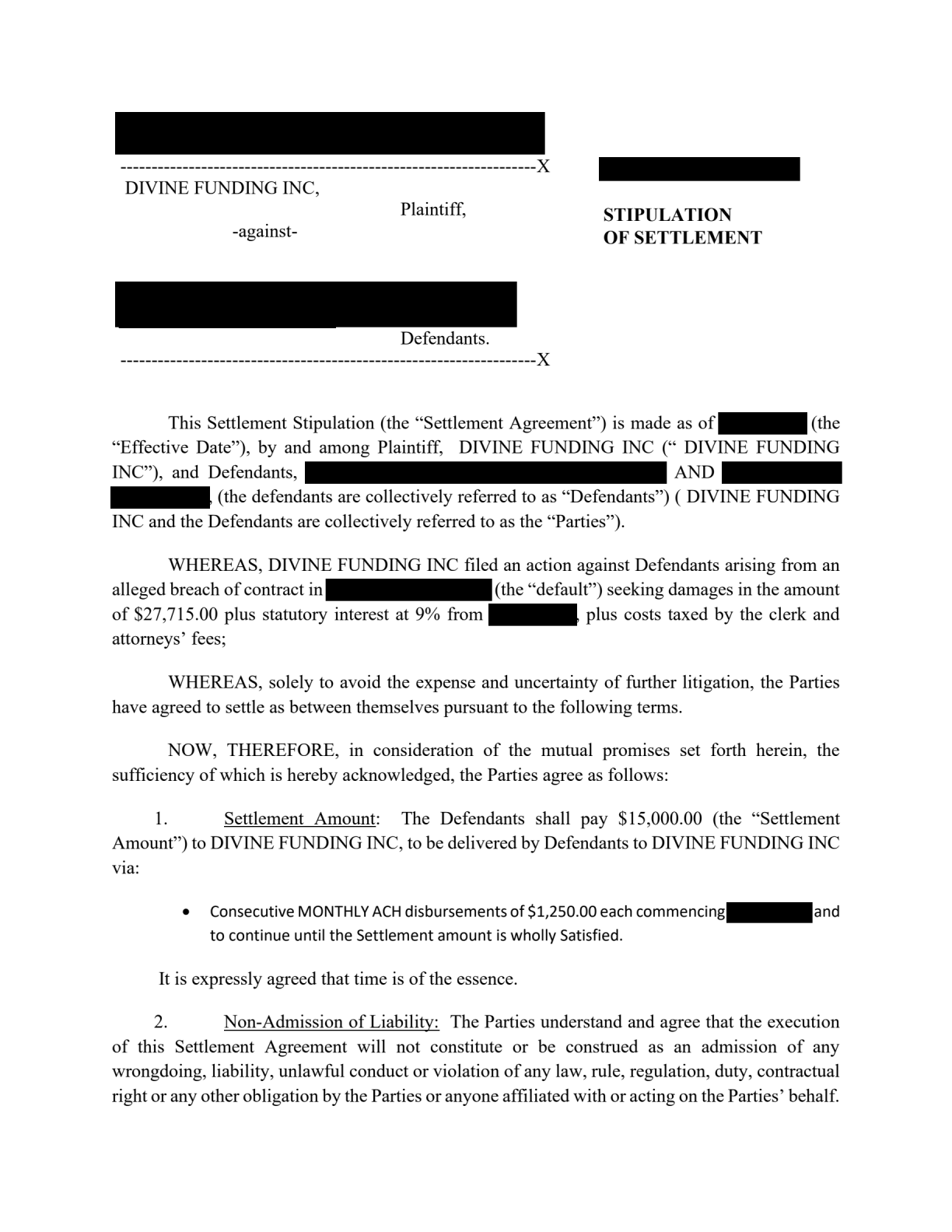
The public excerpt names Divine Funding Inc. and describes a lawsuit arising from an alleged breach of contract. It states a $27,715 claim, plus referenced interest, costs and attorney fees.
The payment section sets out $15,000 through monthly ACH disbursements of $1,250. It also says time is of the essence. Dates and party details are redacted.
A separate clause states that execution does not constitute an admission of wrongdoing or liability by the parties or associated persons. That language should be read precisely: it does not remove the payment obligations or reveal every term on the missing pages.
- Named party
- Divine Funding Inc.
- Schedule shown
- $1,250 monthly ACH toward $15,000
- Separate clause
- Non-admission of liability
- Independent legal representation
- Business Debt Law Group is not affiliated with, endorsed by, or acting for Divine Funding.
Payment terms accompanied by non-admission language
The excerpt describes an alleged breach and $15,000 settlement terms through monthly $1,250 ACH payments. Its non-admission provision distinguishes execution of the settlement from admitting wrongdoing or liability. The record does not establish acceptance, completed performance or any court finding on the underlying allegations.
See more MCA settlement examples ↗
Partial, redacted excerpt from one matter. Other pages, amendments and later events may affect these terms. This discussion does not summarize the complete agreement or case. Acceptance, completed payment, releases and the final outcome require verification from the complete records. This is not a standard offer or promised result. Past results do not guarantee a similar outcome.
Separate the dispute’s allegations from the promises being made
Read the recitals, non-admission clause, acknowledgments and any waivers together. Ask counsel to explain whether other provisions affirm a balance, waive a defense or authorize a remedy despite the non-admission language. One clause should not be treated as the whole agreement.
Confirm the ACH amount, schedule and authorization, and identify how any already-scheduled withdrawal is handled. The visible monthly amounts imply twelve payments, but the complete agreement controls dates, credits and any other conditions. Keep a ledger of what actually clears.
Check notice, cure and default provisions on the remaining pages. The phrase time is of the essence emphasizes timing; this excerpt does not provide a universal grace period. Preserve correspondence if a payment problem develops and obtain advice before changing the arrangement.
Where does your Divine matter stand?
MCA payments are too much
Review monthly affordability and the ACH schedule before agreeing to the settlement’s obligations.
Receivables or accounts are affected
Check which collection activity, if any, is addressed by the complete settlement and when restrictions would be released.
Court papers have arrived
Distinguish allegations in the lawsuit from admissions, waivers and findings actually present in the record.
Four practical first steps.
- Check for a court deadline.If you received court papers, identify where the case is filed and when a response is due. Settlement discussions do not automatically extend a deadline.
- Put the records in one place.Collect the agreement, payment history, bank statements, and every notice. Preserve emails and texts, including any proposed settlement terms.
- Review a proposed change before signing.A new agreement, acknowledgment, release, or guarantee can affect your rights and obligations. Have its terms reviewed in context.
- Discuss a plan for your actual situation.Ask which legal or negotiation options fit the documents, cash flow, and litigation status—and what representation would cost.
Divine MCA questions, answered.
Does the settlement prove either side did something wrong?
No. The excerpt expressly contains non-admission language. Allegations and negotiated terms are not judicial findings.
Does non-admission mean the payments are optional?
No. Review the operative promises and enforceability of the complete agreement with counsel.
How many $1,250 payments equal $15,000?
Twelve. Confirm the unredacted dates, credits and other conditions rather than assuming the arithmetic supplies the whole schedule.
Is there a grace period in the visible page?
The visible page says time is of the essence but does not establish a general grace period. Review the remaining terms.
What does the free MCA review cover?
The initial consultation can address your MCA agreement, payment pressure, collection communications or case status. Consultations are free. Any retained legal-service fees are separate and addressed in the engagement terms.
Let’s review your Divine MCA.
Tell us about the payment demand, proposed agreement or court papers you need help understanding.
General information, not legal advice. Options depend on the agreements, facts, applicable law, and procedural history. No result is guaranteed. Contacting the firm does not create an attorney-client relationship or extend a deadline. Business Debt Law Group provides legal services; it does not provide or arrange financing.