
Negotiating Merchant Cash Advance Settlements: Factors and Considerations
Part I: Analyzing a Business Before Negotiating an Merchant Cash Advance Settlement
When negotiating a business debt settlement, particularly a Merchant Cash Advance (MCA) settlement, it is important to first understand the difference between repayment of the contractual obligation and a negotiated settlement of that obligation.
A repayment generally means that the business owner pays the full contractual amount required under the Merchant Cash Advance agreement. MCA agreements are commonly structured as purchases of future receivables rather than conventional business loans, although the legal characterization of a particular transaction depends on the agreement, payment mechanics, applicable law, and circumstances.
For example, assume a business receives $50,000 under an MCA agreement and the contract identifies $75,000 as the purchased amount or total amount to be remitted. The agreement may provide for daily or weekly ACH withdrawals or other remittances based on the contractual payment structure.
If the business pays the entire $75,000 according to the agreement, that results in full contractual repayment rather than a negotiated MCA debt settlement.
Gross Funding, Net Funding, and the Contractual Repayment Amount
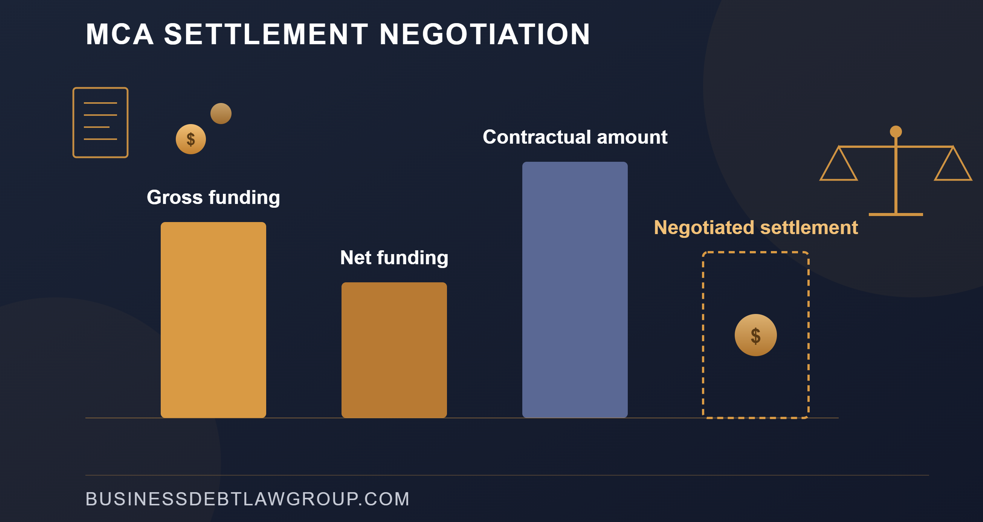
As lawyers, when we examine Merchant Cash Advance obligations for new or potential clients, one of the first things we identify is the amount of gross funding.
Gross funding refers to the stated amount being provided under the transaction before origination fees, broker fees, or other deductions. For example, if the gross funding amount is $50,000 but fees are deducted before the funds reach the business, the business will actually receive less than $50,000.
After reviewing those deductions, we calculate the net funding, the actual amount of money received by the business.
Next, we examine the full contractual repayment or purchased amount. This tells us how much the agreement requires to be remitted if the transaction proceeds according to its contractual payment structure.
The difference between the amount actually received by the business and the total contractual amount to be remitted is an important part of our analysis. We also examine the expected payment period, frequency of withdrawals or remittances, reconciliation provisions, fees, and other contractual terms.
For example, a business might receive $50,000 while the agreement calls for a total of $75,000 to be remitted over a relatively short period.
That $25,000 difference represents a substantial financing cost. However, a factor rate or purchased amount should not automatically be described as an interest rate or APR. Calculating an annualized cost requires consideration of the actual cash received, fees, timing and frequency of payments, and expected repayment period.
This is one reason it is important to review the economic substance of an MCA agreement rather than relying solely on the terminology used in the contract.
How Does MCA Financing Compare With a Traditional Business Loan?
Merchant cash advances and traditional commercial loans are structured differently.
A conventional business loan generally involves principal, an interest rate, repayment terms, and other loan provisions. An MCA agreement is commonly drafted as the purchase of a specified amount of future receivables or revenue.
Whether a particular MCA transaction is legally treated as a true purchase of receivables or instead characterized as a loan can depend on the agreement’s terms, reconciliation provisions, payment structure, allocation of risk, applicable state law, and other circumstances.
Likewise, usury limits and exemptions vary substantially among states and can depend on the type and amount of the transaction, the parties involved, and the law governing the agreement. There is no single 18% interest-rate rule that applies to every commercial loan throughout the United States.
For these reasons, the legal and economic analysis of an MCA transaction requires more than simply comparing its stated factor rate with the interest rate on a conventional commercial loan.
MCA Default Fees and Additional Contractual Charges
If a business cannot maintain the payment schedule required by its MCA agreement, the agreement can provide for additional charges or other consequences following an alleged MCA default.
Missed or failed daily or weekly payments can trigger contractual default provisions, depending on the specific terms of the agreement and the circumstances surrounding the payment interruption.
For example, assume the agreement provides for $75,000 in total remittances on $50,000 in gross funding. If the agreement contains enforceable default-fee provisions, attorneys’ fee provisions, or other contractual charges, the amount claimed by the MCA provider following an alleged default could increase.
The existence, amount, and enforceability of any default fee, attorneys’ fee, or other additional charge should be evaluated under the actual agreement and applicable law rather than assumed from the fact that a payment was missed.
This makes it important to identify several different numbers when evaluating a legal MCA matter:
• Gross funding;
• Net funding actually received;
• Contractually purchased or repayment amount;
• Payments already made;
• Claimed outstanding balance;
• Default fees or other charges being asserted; and
• Any attorneys’ fees, collection costs, or judgment amounts being claimed.
Those figures help establish the financial starting point for a potential Merchant Cash Advance settlement negotiation.
Negotiated MCA Settlement Resolutions
A negotiated settlement resolution is different from full contractual repayment.
A negotiated settlement can occur when an MCA account has become delinquent, disputed, or subject to an alleged default and the business owner, either directly or through qualified legal counsel, seeks to negotiate different terms for resolving the obligation.
The negotiation can involve the amount to be paid, timing of payments, releases, litigation, guarantees, UCC-related issues, and other terms relevant to resolving the dispute.
When a settlement is reached, the written settlement agreement should clearly address the obligations being resolved and any applicable release, lawsuit, judgment, guarantee, UCC-1 filing, or other enforcement issue. A settlement does not automatically produce a lawsuit dismissal, UCC termination, or zero-balance letter unless those matters are addressed by the settlement and appropriate follow-through occurs.
At the Business Debt Law Group, our attorneys evaluate these issues as part of the MCA settlement process.
Business Vulnerability Analysis Before MCA Settlement Negotiation
One of the first steps in evaluating a potential MCA debt settlement is understanding the business’s vulnerability to MCA collection and enforcement activity.
The nature of the business can significantly affect the negotiation strategy.
A business that depends heavily on a particular revenue stream or payment processor can present different risks from a business with diversified revenue sources and customers.
When our law firm evaluates a business owner’s vulnerability position in relation to one or more MCA providers, we consider factors including:
• How the business generates revenue;
• How customers pay the business;
• Whether significant revenue is processed through credit or debit cards;
• Whether commercial customers pay by check or wire;
• Whether the business receives insurance-related payments;
• Whether customers are primarily consumers or commercial entities;
• Whether there are existing UCC filings;
• Whether other secured creditors have competing claims;
• Whether litigation or judgments already exist; and
• Whether multiple MCA obligations are being paid simultaneously.
This analysis helps us identify which collection or enforcement actions could create the greatest operational pressure and which issues should be prioritized during settlement negotiations.
UCC § 9-406 Demand Notice Vulnerability
Once we understand how the business receives its revenue, we can evaluate potential exposure to UCC § 9-406 demand notices and related receivables issues.
Many MCA agreements include provisions concerning receivables and security interests, and an MCA provider can file a UCC-1 financing statement in connection with the transaction.
A UCC-1 financing statement generally serves a public-notice function. The filing itself does not establish the amount owed, prove a default, determine lien priority, or automatically establish every enforcement right claimed by the MCA provider.
UCC § 9-406 addresses circumstances involving notification of an assignment and payment by an account debtor.
An MCA provider or its representatives can send a notice asserting rights in receivables and directing a business’s customer or another account debtor to redirect payment.
Whether a particular UCC § 9-406 notice requires payment to be redirected depends on the underlying assignment or security interest, the content and effectiveness of the notice, applicable UCC provisions, competing rights, and other facts. An account debtor can also have the right to request reasonable proof of the claimed assignment.
This is why we refer to the issue as UCC § 9-406 demand vulnerability or UCC lien disruption vulnerability.
UCC Notices Sent to Payment Processors
Payment processors can become important in MCA disputes because many businesses depend on daily credit- and debit-card revenue.
An MCA provider can send a UCC-related notice to a processor or electronic payment company asserting an interest in the business’s receivables.
The processor’s response can vary based on its contract, the notice received, competing claims, applicable law, and its own compliance procedures. Funds can sometimes be held, redirected, or otherwise affected while the competing claims are reviewed, but a UCC filing or demand notice does not automatically require every processor to freeze a merchant’s account.
Consider a restaurant that depends heavily on credit- and debit-card receipts. If a processor holds or redirects several days of revenue after receiving a demand notice, the interruption can create immediate cash-flow pressure.
The legal and practical options for addressing the disruption depend on the underlying documents, the claimed assignment, lien priority, the processor’s position, and the circumstances of the dispute. Settlement can be one possible path, but it is not necessarily the only means of addressing the issue.
Can an MCA Funder Contact a Business’s Customers?
MCA providers can also send notices asserting receivables rights directly to a business’s commercial customers.
For example, suppose a general contractor performs substantial work for a real estate developer. If the developer receives a notice asserting that payments owed to the contractor have been assigned or are subject to another party’s security interest, the developer can decide to hold payment while determining who is legally entitled to receive the funds.
For a business expecting tens or hundreds of thousands of dollars in receivables, that type of disruption can create substantial operating pressure.
However, the receipt of a UCC § 9-406 notice does not by itself resolve whether the sender is legally entitled to the receivable. The underlying assignment, security interest, notice, proof of assignment, competing liens, contract terms, and applicable law can all require review.
Our law firm has experience addressing UCC demand situations and disputes involving receivables that customers or other account debtors have placed on hold.
Depending on the facts, potential steps can include reviewing the demand and supporting documents, communicating with the account debtor or other parties, requesting or evaluating proof of assignment, analyzing competing UCC interests, negotiating with the MCA provider, and considering available legal remedies.
Business Debt Law Group also provides additional resources addressing UCC § 9-406 demand notices, UCC filings, and MCA creditor lawsuits in greater detail.
How Vulnerability Affects MCA Settlement Strategy
Understanding the business’s vulnerability helps attorneys determine how to approach an MCA settlement negotiation.
A company that relies almost entirely on one payment processor or a small group of commercial customers can face different settlement pressures than a company whose revenue is distributed across many independent sources.
Other important factors can include:
• The amount originally funded;
• Net funding actually received;
• Total amount already paid;
• Current balance claimed by the funder;
• Number of MCA obligations;
• Existing UCC filings;
• Personal guarantees;
• Pending lawsuits or judgments;
• Bank restraints;
• Customer or processor demands;
• Current business cash flow; and
• The business’s ability to fund a negotiated resolution.
There is no single settlement formula that applies to every MCA dispute. The appropriate negotiation strategy depends on the agreements, financial circumstances, funder actions, litigation posture, available defenses, and applicable law.
Speak With Business Debt Law Group About MCA Settlement Negotiations
The attorneys at Business Debt Law Group are available for free consultations with business owners dealing with merchant cash advance obligations.
We can review the MCA agreements, payment history, claimed balances, UCC filings, demand notices, lawsuits, judgments, personal guarantees, and current business circumstances to evaluate potential MCA debt settlement, negotiation, restructuring, and legal strategies.
A case review does not itself stop withdrawals, release restrained funds, terminate a UCC filing, dismiss a lawsuit, or guarantee a particular settlement result. Any available options depend on the facts of the matter and applicable law.
Frequently Asked Questions
What is the difference between MCA repayment and MCA debt settlement?
MCA repayment generally means paying the full contractual amount required under the agreement. An MCA debt settlement involves negotiating different terms for resolving the obligation, which can include the amount paid, payment timing, releases, litigation, guarantees, UCC-related issues, and other settlement terms.
How is a merchant cash advance settlement amount determined?
There is no standard settlement formula. Attorneys can review the gross and net funding, contractual repayment amount, payments already made, claimed balance, business cash flow, MCA agreements, funder actions, personal guarantees, UCC filings, and litigation status when evaluating potential settlement strategies.
Can an MCA balance increase after a default?
An MCA provider can assert additional default fees, attorneys’ fees, collection costs, or other charges if permitted by the agreement and applicable law. The claimed balance and the basis for additional charges should be reviewed before settlement negotiations.
What should be reviewed before negotiating an MCA settlement?
Important factors can include the MCA agreement, funding and payment history, current balance claimed by the funder, reconciliation provisions, default provisions, UCC filings, personal guarantees, lawsuits, judgments, bank restraints, business revenue, and ability to fund a negotiated resolution.
What is a UCC § 9-406 demand notice in an MCA dispute?
A UCC § 9-406 demand notice can assert rights to certain receivables and direct an account debtor to make payment to another party. Whether the notice requires payment to be redirected depends on the underlying transaction, assignment or security interest, notice, supporting proof, competing rights, and applicable law.
Can an MCA funder contact my customers or payment processor?
An MCA funder can send notices asserting rights involving business receivables to customers, processors, or other account debtors. The legal effect of those notices and how a recipient responds depend on the agreement, UCC issues, competing claims, applicable law, and the particular circumstances.
Does a UCC-1 filing mean an MCA funder automatically owns my receivables?
No. A UCC financing statement generally serves a public-notice function. The filing alone does not establish the amount owed, prove default, determine lien priority or collateral scope, or establish every enforcement right asserted by the MCA funder.
Can a merchant cash advance settlement resolve a lawsuit or UCC filing?
A negotiated settlement can address lawsuits, UCC filings, releases, guarantees, judgments, and other enforcement issues when applicable. However, those matters should be specifically addressed in the written settlement and appropriate follow-through completed; settlement does not automatically resolve each issue.
How does business vulnerability affect MCA settlement negotiations?
A business that depends heavily on one payment processor, a few commercial customers, or another concentrated revenue source can face different collection and operational risks. Understanding those vulnerabilities can help attorneys determine which issues should be prioritized during settlement negotiations.
Does hiring an MCA attorney guarantee a reduced settlement?
No. MCA settlement is a negotiated process, and no specific reduction, payment arrangement, timing, or outcome can be guaranteed. Potential strategies depend on the agreements, payment history, business circumstances, funder actions, litigation posture, and applicable law.