
Merchant Cash Advance Help: How to Check Online Advice
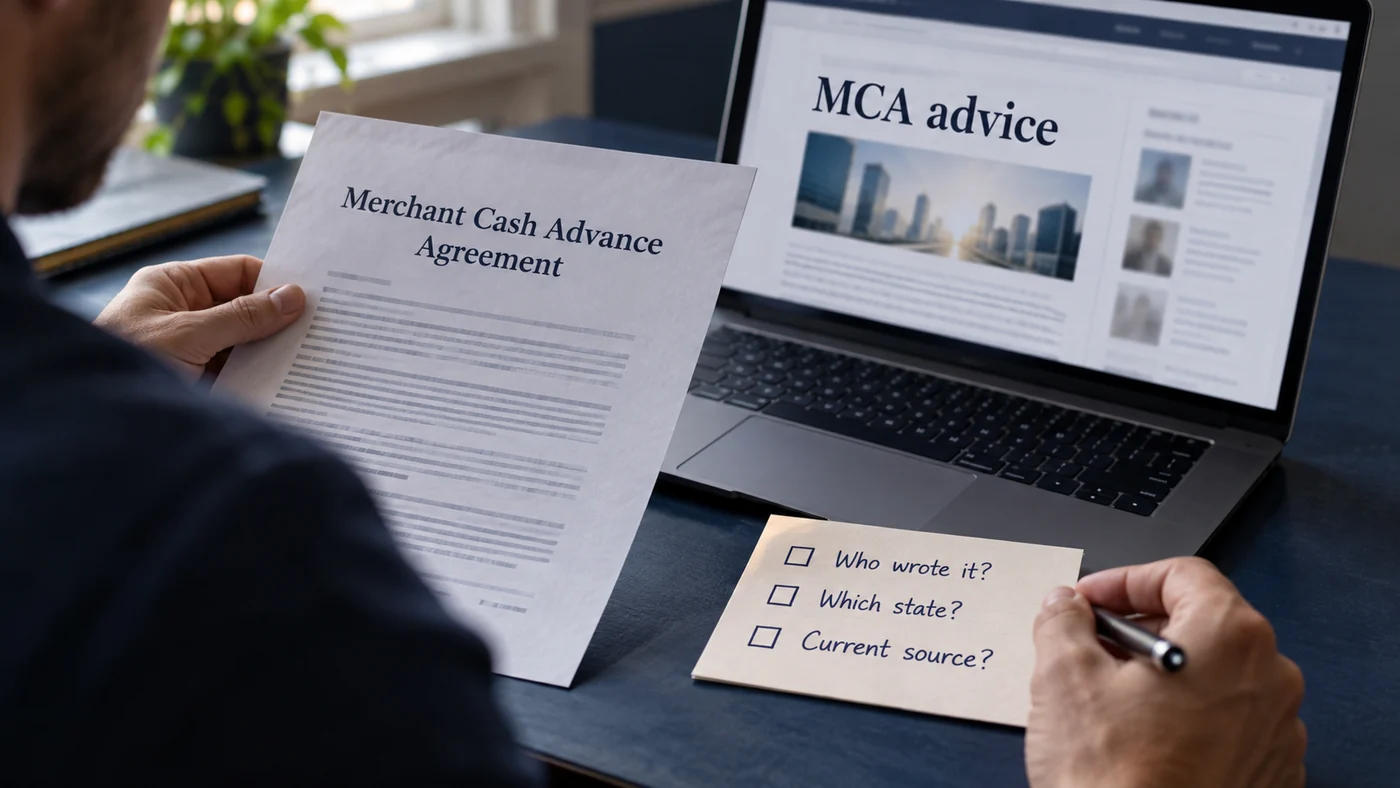
When you search for merchant cash advance help, check who wrote the advice, what supports it and whether it applies to your situation. A high search ranking, polished website or confident answer is not proof that a claim is correct.
MCA search results can mix funding offers, legal information, debt-settlement advertising, news reports and personal experiences. Each can answer a different question. An explanation of how to obtain an advance may offer little help when you already have several withdrawals you cannot afford or a lawsuit requiring a response.
Start with your actual problem: understanding a contract, comparing payment options, reviewing a collection demand or responding to court papers. Then evaluate the information against that problem. This guide is about checking sources; our guide to choosing MCA help covers the separate decision of hiring a provider.
Use five checks before relying on MCA advice
The CRAAP framework—Currency, Relevance, Authority, Accuracy and Purpose—comes from the Meriam Library at California State University, Chico. Applied to MCA research, it gives you five practical checks.
Currency: when was the underlying information current?
Look for the publication date and the date of the law, court decision or data being discussed. A recent “updated” label does not establish that every citation was checked. A historical story can remain valuable while no longer describing today’s rules.
Relevance: does it address your transaction and location?
Consumer credit-card advice may not apply to business MCA contracts. A rule in one state may not control your agreement or lawsuit. Watch for distinctions between an unpaid balance, an MCA UCC filing, a pending case and an entered judgment; they are not interchangeable situations.
Authority: can you identify and verify the author?
Look for a named writer and relevant experience. For legal advice, verify the individual lawyer’s registration with the appropriate licensing authority. A job title, professional photograph or “expert” label is a starting point for verification, not a substitute for it.
Accuracy: can the claim be traced to evidence?
Follow citations. Does the linked source actually support the sentence? Is a number based on a defined study, a particular case or an unsupported estimate? Several websites repeating the same claim do not necessarily provide independent confirmation.
Purpose: what does the publisher want you to do?
Identify whether the page sells funding, referrals, settlement services or legal representation. A commercial purpose does not automatically make information false, and an educational label does not guarantee neutrality. Look for a fair explanation of limits, costs and circumstances in which the proposed solution may not fit.
Match the source to the question
- What did I agree to? Start with the signed agreement, amendments, funding disclosures and actual payment records. A general article cannot establish the contents of your contract.
- What does the law say? Look for the current statute, official regulation or court opinion, along with an explanation of its jurisdiction and limits.
- What happened in an enforcement case? Read the agency’s release and linked filings. A complaint describes allegations; an order or judgment may establish a different procedural outcome.
- What did another owner experience? Reviews, interviews and discussion boards can suggest useful questions, but they do not establish what will happen in your matter.
- What will a provider do for me? Compare the written engagement with the advertising. Identify the actual services and who is responsible for them.
For example, the FTC’s October 2023 announcement about RCG Advances reports a specific enforcement outcome. It is a useful primary source for that case, not proof that every MCA contract or company is unlawful.
Read older reporting as historical context
The 2018 Bloomberg investigation into confessions of judgment and NBC’s 2020 reporting on pandemic-era MCA concerns provide historical context. Neither should be presented as recent reporting or used alone to determine current legal rights. Our 2020 COVID-era MCA article is also historical background, not a statement of current relief programs or legal rules.
This matters when an older article discusses a procedure that has since changed. Check the current official rule, the dates relevant to your transaction and the court involved. Our confession-of-judgment guide explains why the distinction between a confession and an ordinary lawsuit matters.
Test the claim, not just the presentation
If a page says “this will cut your payments in half,” look for the missing details: half of which payment, for how long, at what total cost, and under whose written agreement? If it promises to stop a lawsuit, ask what legal action would be taken and whether a creditor or court must agree.
Check cost comparisons particularly carefully. A factor rate is not an APR, and a smaller scheduled payment does not necessarily mean a smaller total obligation. An example should state its assumptions clearly.
AI summaries deserve the same scrutiny. Open the cited source and confirm that it exists, supports the answer and remains applicable. Good grammar and professional design cannot establish legal accuracy; an awkwardly written source is not automatically wrong either. For examples of claims to check against the documents, see MCA myths, scams and contract facts.
Save the exact offer, email, article date and relevant contract language when a claim influences your decision. That record makes it easier to ask a precise question and compare an explanation with what was actually promised.
Know the limits of this website, too
Business Debt Law Group publishes information for businesses facing MCA payment disputes and related legal issues, and offers legal representation. That is our perspective and commercial purpose. Our articles should help you understand questions to discuss; they cannot decide your case without the agreements, facts and applicable law.
If you need merchant cash advance legal help, bring the source or promise you are unsure about along with your contract and any legal papers. Consultations are always free. If you have been served with a lawsuit, do not let continued online research replace prompt attention to the response deadline. Contact BDLG to discuss your situation.
General educational information, not legal advice for a particular matter. Links to outside sources are provided for context, not as an endorsement of every statement or service on those sites. Reading this article or contacting the firm does not by itself create an attorney-client relationship.
Free MCA Review or Case Evaluation
Have questions about your MCA agreements, payment pressure, or court papers? You do not need a lawsuit to request a free review.
Consultations are free; retained legal-service fees are separate. Contacting the firm does not create an attorney-client relationship or extend a deadline. No outcome is guaranteed.