
Settlement Negotiation Strategies After Identifying Risk Exposure
Negotiating Business Debt Settlements – Part II
Before reading Part II, we recommend reviewing Part I of our Negotiating Business Debt Settlements series, which explains the difference between repayment and negotiated settlement, how MCA balances are analyzed, default-related charges, and how our attorneys evaluate a business’s vulnerability to UCC § 9-406 demand notices and potential revenue disruption. Part II continues that analysis by discussing how identified risk exposure can affect Merchant Cash Advance settlement negotiation strategies.
Once our lawyers have assessed a business’s vulnerability to UCC lien disruption, we can then decide how to proceed with potential settlement negotiations and legal strategies.
If our client is reliant upon insurance payors or commercial customers whose payments could potentially be affected by a UCC § 9-406 demand notice, our approach can involve prioritizing settlement and restructuring discussions to address the potential impact on the business’s cash flow and operations.
In other words, if the business is particularly vulnerable to UCC-related revenue disruption, the timing of settlement negotiations can become an important strategic consideration. Prolonged disputes or litigation can present additional business risks when significant receivables are potentially affected.
In this type of UCC-vulnerability situation, our settlement strategy can place greater emphasis on reducing the recurring payment obligation and negotiating a longer payment period rather than focusing exclusively on obtaining the largest possible reduction in the claimed balance.
For example, if an MCA agreement calls for payments equating to $5,000 per week or approximately $20,000 per month, one potential restructuring strategy could involve negotiating substantially lower recurring payments over a longer period. The specific payment amount, settlement balance, and length of the repayment period depend on the circumstances of the business and the terms the MCA provider is willing to negotiate.
A reduction in recurring payment pressure can improve cash-flow flexibility, but no specific payment reduction, balance reduction, settlement term, or financial outcome can be guaranteed.
Settlement Strategy When UCC Revenue-Disruption Risk Is Lower
On the other hand, if, after conducting our analysis, we determine that a client has lower exposure to UCC-related revenue disruption, meaning, for example, that the business does not heavily rely on credit card processing, third-party service platforms such as DoorDash, Uber Eats, or Grubhub, a small number of major commercial customers, or insurance company reimbursements, the immediate risk of revenue disruption can be different.
In those circumstances, if an MCA provider files a breach-of-contract lawsuit, our attorneys can evaluate the agreement, allegations, payment history, reconciliation provisions, personal guarantees, claimed damages, available defenses, and procedural posture before determining an appropriate litigation and settlement strategy.
Depending on the facts, defending the lawsuit while continuing to evaluate settlement opportunities can provide a different negotiation framework than a matter involving immediate receivables disruption.
The decision to litigate should be based on the merits of the case, available defenses, costs, risks, applicable law, and the business owner’s objectives, not simply as a means of delaying resolution or attempting to obtain a particular settlement discount.
Likewise, lower vulnerability to UCC-related disruption does not guarantee a larger settlement reduction.
The amount of any negotiated settlement can depend on the amount originally funded, payments already made, claimed outstanding balance, litigation status, financial circumstances of the business, available settlement funds, legal issues involved, and willingness of the MCA provider to negotiate.
While prior matters can provide useful context for settlement analysis, no specific percentage reduction, including a 60% reduction or any other discount, can be promised or predicted for a particular client. Past results do not guarantee a similar outcome.
Business Debt Law Group evaluates litigation and settlement options based on the jurisdiction, facts of the matter, and the attorneys and resources available for the particular case.
Escrow Services, Lump-Sum, Short-Term, and Long-Term Settlement Structures
Our law firm can discuss settlement-funding arrangements with clients who want to accumulate funds that could potentially be used toward a negotiated settlement. Any such arrangement should be explained in accordance with the applicable engagement terms and requirements governing the handling of client funds.
Some clients can have funds available for a one-time lump-sum MCA settlement, while others can require a short-term or longer-term settlement structure.
The amount and timing of funds available for settlement can affect negotiations. An MCA provider can be willing to consider different terms when settlement funds are available sooner, but a lump-sum or short-term offer does not guarantee a particular discount.
Depending on the circumstances, settlement proposals can involve a lump-sum payment, several short-term installments, or payments extending over a longer period.
Longer settlement structures can reduce the amount of each recurring payment, although the total settlement amount and other terms can differ from those available through a lump-sum or shorter-term resolution.
The appropriate structure depends on factors such as the claimed balance, business cash flow, funds available for settlement, litigation status, MCA provider, and the terms the parties are willing to negotiate.
No particular MCA provider, including a licensed financing company, can be assumed to offer a specific 12-, 18-, 24-, or 36-month settlement term in every matter. Settlement terms must be evaluated based on the individual circumstances and the provider’s position at the time of negotiation.
How Risk Exposure Can Affect MCA Settlement Negotiations
Depending on the results of our analysis concerning vulnerability to revenue disruption, our attorneys can determine how that risk should factor into settlement discussions.
If there is significant potential for revenue disruption, earlier settlement or restructuring discussions can be appropriate to evaluate whether the payment pressure and underlying dispute can be addressed before additional operational problems develop.
In those circumstances, the strategy can focus on negotiating potential changes to recurring payments, settlement terms, or the duration of payments while addressing UCC-related issues affecting the business.
The commencement of settlement negotiations does not itself stop UCC-related activity, release funds, stop ACH withdrawals, terminate a UCC filing, or prevent further collection or litigation activity.
If our client has less exposure to revenue disruption, our attorneys can have additional considerations when evaluating litigation and settlement strategy.
That does not necessarily mean prolonged litigation will result in a larger settlement discount. Instead, the attorneys can evaluate whether litigation should be defended, whether settlement discussions should continue, and what resolution strategies are appropriate based on the legal and financial circumstances.
If the client has funds available for a potential lump-sum settlement, that can be considered as part of the negotiation strategy.
If the client instead requires a longer settlement structure, our attorneys can evaluate whether extended payment terms can be negotiated and whether the proposed payment arrangement is financially realistic for the business.
Factors Our Attorneys Consider When Developing an MCA Settlement Strategy
• There is no single merchant cash advance settlement strategy that applies to every business.
• When evaluating a potential MCA debt settlement, our attorneys can consider:
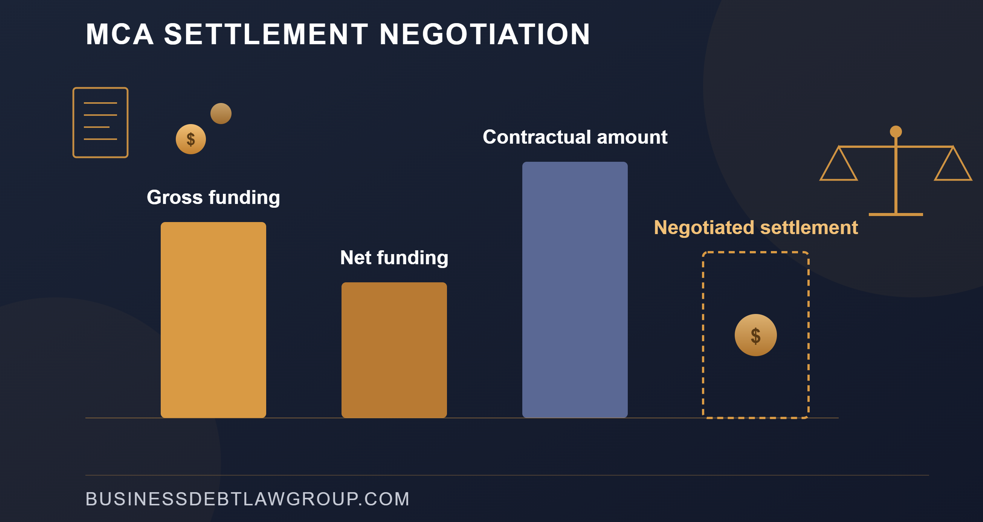
• The gross and net funding received;
• The contractual purchase or repayment amount;
• Payments already made;
• The balance currently claimed by the MCA provider;
• The number of outstanding MCA agreements;
• Current business revenue and cash flow;
• Dependence on credit card processors or payment platforms;
• Insurance receivables;
• Concentration of commercial customers;
• Existing UCC filings;
• UCC § 9-406 demand notices;
• Personal guarantees;
• Pending MCA lawsuits;
• Judgments or bank restraints;
• Reconciliation provisions;
• Actions taken by the MCA provider;
• Available legal or contractual issues and defenses; and
• Funds potentially available for settlement.
Evaluating these factors together helps our attorneys determine which negotiation, settlement, restructuring, or litigation strategies can be appropriate for the particular business.
Experience With MCA Providers and Their Attorneys
The attorneys at Business Debt Law Group are familiar with many MCA providers, collection practices, and attorneys involved in merchant cash advance disputes.
Different MCA providers and their representatives can approach defaults, UCC-related activity, lawsuits, negotiations, and settlement discussions differently.
Prior experience involving a particular MCA provider or opposing attorney can provide useful context when evaluating a matter, but it does not determine how that party will respond or what settlement terms will be available in another case.
Our attorneys bring their experience with merchant cash advance matters and commercial debtor-creditor disputes to the evaluation and representation of business clients.
Each matter is nevertheless evaluated independently based on its agreements, payment history, funder actions, financial circumstances, procedural status, and applicable law.
Developing a Focused MCA Debt Settlement Strategy
Is your business vulnerable to revenue disruption?
Are you relying on insurance carriers for payment?
Are you dependent on a particular credit card processor because of a specific point-of-sale system?
Are you reliant on one or two major commercial customers or brokers for a substantial portion of your business revenue?
Have customers, processors, insurers, or other account debtors received UCC-related notices concerning your receivables?
Are you currently facing an MCA lawsuit, judgment, bank restraint, disputed ACH withdrawals, or enforcement activity?
Once we understand these issues, our attorneys can better evaluate potential strategies for addressing the MCA obligations and related legal or financial pressure.
Depending on the circumstances, those strategies can involve settlement negotiations, restructuring discussions, reconciliation issues, litigation defense, UCC-related analysis, or other available legal options.
Free MCA Case Evaluation
The attorneys at Business Debt Law Group are available for a free MCA case evaluation to help business owners understand their MCA agreements, claimed balances, payment pressure, UCC-related exposure, litigation status, and potential settlement considerations.
Our attorneys can review the business’s MCA agreements, payment history, UCC filings, UCC § 9-406 demand notices, personal guarantees, lawsuits, judgments, funder actions, and current financial circumstances.
Based on that review, we can evaluate potential merchant cash advance settlement, negotiation, restructuring, litigation, and other legal strategies based on the facts and applicable law.
A case evaluation does not itself stop withdrawals, release restrained funds, terminate UCC filings, prevent collection activity, or guarantee a settlement. No specific settlement discount, payment reduction, payment term, timeframe, or outcome can be promised.
We welcome the opportunity to speak with business owners about their circumstances and help them better understand the MCA debt settlement options and potential legal strategies that can be evaluated for their particular situation.
Received a demand notice, a payment hold, or MCA court papers? Free MCA review or case evaluation. No lawsuit is required.
General information, not legal advice. Contacting the firm does not create an attorney-client relationship. Results depend on the facts and applicable law.
Frequently Asked Questions
What is the difference between MCA repayment and MCA debt settlement?
MCA repayment generally means paying the full contractual amount required under the agreement. An MCA debt settlement involves negotiating different terms for resolving the obligation, which can include the amount paid, payment timing, releases, litigation, guarantees, UCC-related issues, and other settlement terms.
How is a merchant cash advance settlement amount determined?
There is no standard settlement formula. Attorneys can review the gross and net funding, contractual repayment amount, payments already made, claimed balance, business cash flow, MCA agreements, funder actions, personal guarantees, UCC filings, and litigation status when evaluating potential settlement strategies.
Can an MCA balance increase after a default?
An MCA provider can assert additional default fees, attorneys’ fees, collection costs, or other charges if permitted by the agreement and applicable law. The claimed balance and the basis for additional charges should be reviewed before settlement negotiations.
What should be reviewed before negotiating an MCA settlement?
Important factors can include the MCA agreement, funding and payment history, current balance claimed by the funder, reconciliation provisions, default provisions, UCC filings, personal guarantees, lawsuits, judgments, bank restraints, business revenue, and ability to fund a negotiated resolution.
What is a UCC § 9-406 demand notice in an MCA dispute?
A UCC § 9-406 demand notice can assert rights to certain receivables and direct an account debtor to make payment to another party. Whether the notice requires payment to be redirected depends on the underlying transaction, assignment or security interest, notice, supporting proof, competing rights, and applicable law.
Can an MCA funder contact my customers or payment processor?
An MCA funder can send notices asserting rights involving business receivables to customers, processors, or other account debtors. The legal effect of those notices and how a recipient responds depend on the agreement, UCC issues, competing claims, applicable law, and the particular circumstances.
Does a UCC-1 filing mean an MCA funder automatically owns my receivables?
No. A UCC financing statement generally serves a public-notice function. The filing alone does not establish the amount owed, prove default, determine lien priority or collateral scope, or establish every enforcement right asserted by the MCA funder.
Can a merchant cash advance settlement resolve a lawsuit or UCC filing?
A negotiated settlement can address lawsuits, UCC filings, releases, guarantees, judgments, and other enforcement issues when applicable. However, those matters should be specifically addressed in the written settlement and appropriate follow-through completed; settlement does not automatically resolve each issue.
How does business vulnerability affect MCA settlement negotiations?
A business that depends heavily on one payment processor, a few commercial customers, or another concentrated revenue source can face different collection and operational risks. Understanding those vulnerabilities can help attorneys determine which issues should be prioritized during settlement negotiations.
Does hiring an MCA attorney guarantee a reduced settlement?
No. MCA settlement is a negotiated process, and no specific reduction, payment arrangement, timing, or outcome can be guaranteed. Potential strategies depend on the agreements, payment history, business circumstances, funder actions, litigation posture, and applicable law.