
Merchant Cash Advance Risks: Six Warning Signs to Review
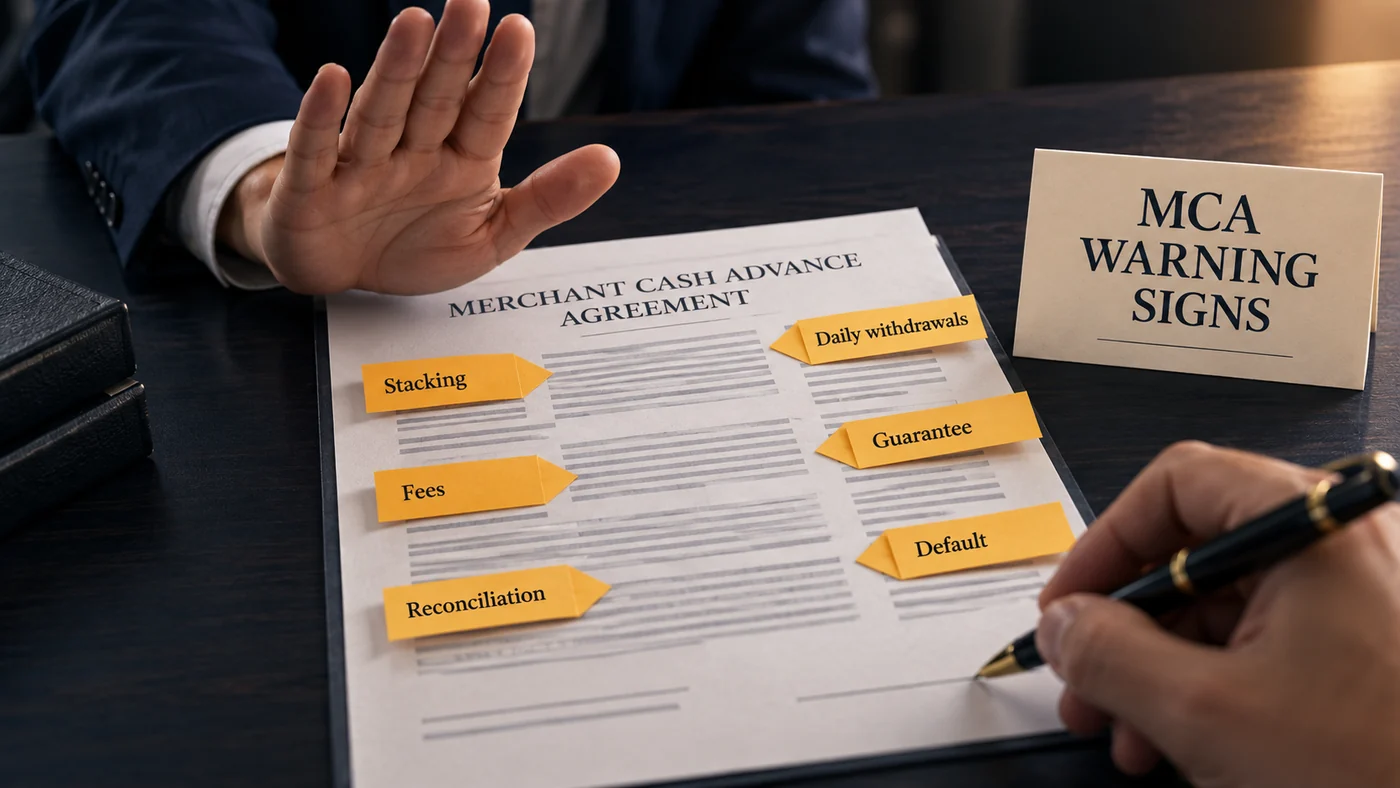
The strongest warning sign is often in the bank account: the MCA keeps collecting, but ordinary operations no longer fit around the withdrawals.
An expensive merchant cash advance is not automatically unlawful, and a business struggling with payments is not automatically headed for closure. The useful question is whether the agreement, funding and actual collections expose a specific problem that needs attention.
This guide is for owners who already have an MCA and want to recognize the warning signs. It separates affordability problems from disputed conduct and urgent legal events, because each calls for a different next step.
Warning sign 1: the deposit does not match what you understood
Compare the quoted advance with the funding statement and actual deposit. Identify fees, broker compensation, payments to an existing funder and any other deductions. A difference is a reason to reconcile the records; it does not, by itself, prove fraud. Our MCA myths and contract facts guide helps separate a sales claim from what the documents actually provide.
If the explanation changes or a deduction was not disclosed as required, keep the original offer and full signed package. Write down the exact difference and ask for an itemized explanation. “I received less than expected” becomes much more useful when the missing amount and promised figure are documented.
Warning sign 2: daily withdrawals consume money needed to operate
Gross revenue is not the same as cash available for MCA payments. A business may show substantial deposits while payroll, rent, inventory, taxes and operating expenses absorb most of them.
Map a typical week and a slower week using actual bank activity. Include every MCA, not just the newest one. Look for repeated overdrafts, returned payments, delayed payroll or a need to use new funding to cover ordinary expenses.
A smaller-looking daily amount can still be difficult when several funders collect at once. If the schedule no longer works, review what to examine when MCA payments leave the business short. Avoid choosing which obligations to stop solely from an online priority list. Use these checks for online MCA advice before relying on a suggested payment strategy.
Warning sign 3: sales fall but the withdrawal never changes
An estimated debit may not automatically adjust with each day’s receipts. Locate the agreement’s reconciliation or adjustment clause and determine how a request must be submitted.
Keep the request, supporting bank statements, sales records, delivery confirmation and response. If the provider rejects the request, identify its stated reason. Was a required document missing? Does it dispute the revenue figure? Does the actual process make an adjustment unavailable?
The answers can matter both to payment discussions and the legal analysis of the agreement. Our MCA reconciliation guide explains the records to preserve. A revenue decline is not, on its own, permission to ignore all contractual duties.
Warning sign 4: renewals provide little new cash but restart a large obligation
A renewal can use a substantial part of the new advance to pay an existing balance. The business may receive a relatively small deposit while undertaking a new purchased amount and collection schedule.
Compare the old payoff, new net cash, new total obligation and combined payments. Ask which existing agreements are actually satisfied and which remain outstanding. If the proposed arrangement funds old payments over time, review how reverse consolidation differs from a payoff.
Also check restrictions on additional financing or sales of receivables. A new provider’s approval does not erase an earlier contract provision.
Warning sign 5: the cost is explained only as a factor or a daily payment
A factor and a payment amount tell only part of the story. Review the money provided, total collections, additional fees and timing. Use the factor-rate guide to distinguish a contractual multiplier from APR.
Ask for a written early-payoff figure rather than assuming the remaining cost disappears when the agreement is paid sooner. Discount terms, fees and the amount already collected may affect the quote.
There is no universal interest-rate range or settlement percentage that determines whether your particular MCA is “bad.” A legal review must address the actual agreement, the provider’s conduct and applicable law. An MCA’s label does not alone decide whether it is legally treated as a loan.
Warning sign 6: collection moves beyond routine payment demands
Court papers, a frozen account, a judgment notice or a demand directed to your customers or payment processor deserve prompt attention. Save the entire notice, including attachments, the envelope and delivery details.
Identify what actually happened. A threatened lawsuit is different from a filed case; an MCA UCC filing is different from a judgment; a demand to a processor is different from a court-ordered restraint. Each can involve different rights and response procedures.
Do not assume a creditor cannot enforce an agreement because you have complained, disputed the balance or started settlement discussions. Consult the MCA lawsuit guide if a case has been filed. A lawyer can assess service, deadlines, contractual provisions and potential defenses.
What these warning signs do—and do not—prove
A cash-flow problem does not establish a legal defense. A contract dispute does not guarantee a balance reduction. At the same time, it is incorrect to say MCA companies operate outside every state and federal law.
The FTC has explained its authority over unfair or deceptive small-business financing practices. State disclosure requirements, contract law and the transaction’s legal classification can also matter. Their application depends on the facts and jurisdiction.
Organize the issue into one sentence before seeking help: “the funding was short,” “our receipts dropped and the adjustment was denied,” “the payoff figures do not reconcile,” or “we were served.” That gives a review a useful starting point.
Get the MCA reviewed before the problem grows
Business Debt Law Group assists owners with merchant cash advance payment disputes, negotiations and related litigation. Depending on the matter, a review may address reconciliation, a negotiated workout, settlement terms or a lawsuit response. None is automatic, and the right sequence depends on the immediate issue.
Consultations are always free. Bring the agreements, recent bank activity and relevant notices so the discussion can focus on your MCA. Services and fees for any representation are agreed separately.
This article is general information, not individualized legal or financial advice. Do not change payment arrangements, move assets or disregard court papers based solely on an article. No settlement, payment reduction or litigation outcome is guaranteed.
Free MCA Review or Case Evaluation
Have questions about your MCA agreements, payment pressure, or court papers? You do not need a lawsuit to request a free review.
Consultations are free; retained legal-service fees are separate. Contacting the firm does not create an attorney-client relationship or extend a deadline. No outcome is guaranteed.