
Cloudfund Lawsuit or Frozen MCA Receivables?

When receivables are held, a settlement number is only part of the problem. Review where the money is, how it will be credited and what must happen before normal collections resume.
Free MCA review or case evaluation.
No lawsuit is required to ask for help.


The Cloudfund file
Cloudfund LLC is the plaintiff named in the redacted settlement and general-release document in BDLG’s public library. That document describes a hold or lien involving the defendants’ account receivables. It provides a useful starting point for reviewing both the claimed balance and money that may already be outside the business’s control.
If a customer or processor has received an MCA demand, preserve that notice separately from the settlement proposal. Identify who received it, who is holding funds, the amount affected and whether money has already been transferred. A statement in a settlement recital does not independently establish that every asserted lien or collection right is enforceable.
Use the exact company name on your agreement and court papers. Similar trading names can appear in MCA records; this guide concerns Cloudfund and the Cloudfund LLC example below. It does not treat another company’s contract or lawsuit as yours.
- Party named in the example
- Cloudfund LLC, identified as plaintiff.
- Document type
- Stipulation of settlement and general release.
- Central question
- How held receivables, settlement credits and release instructions work together.
- Independent legal representation
- Business Debt Law Group is not affiliated with, endorsed by, or acting for Cloudfund.
A Cloudfund settlement involving held receivables.
BDLG’s published example records $20,000 in settlement terms against a $28,310 comparison amount. The visible excerpt identifies held receivables and contains consent and waiver provisions. Those details make the complete agreement important: the public image alone does not establish how every dollar was applied or when every restriction ended.
See more MCA settlement examples ↗
Partial, redacted excerpt from one matter. Other pages, amendments and later events may affect these terms. This discussion does not summarize the complete agreement or case. Acceptance, completed payment, releases and the final outcome require verification from the complete records. This is not a standard offer or promised result. Past results do not guarantee a similar outcome.
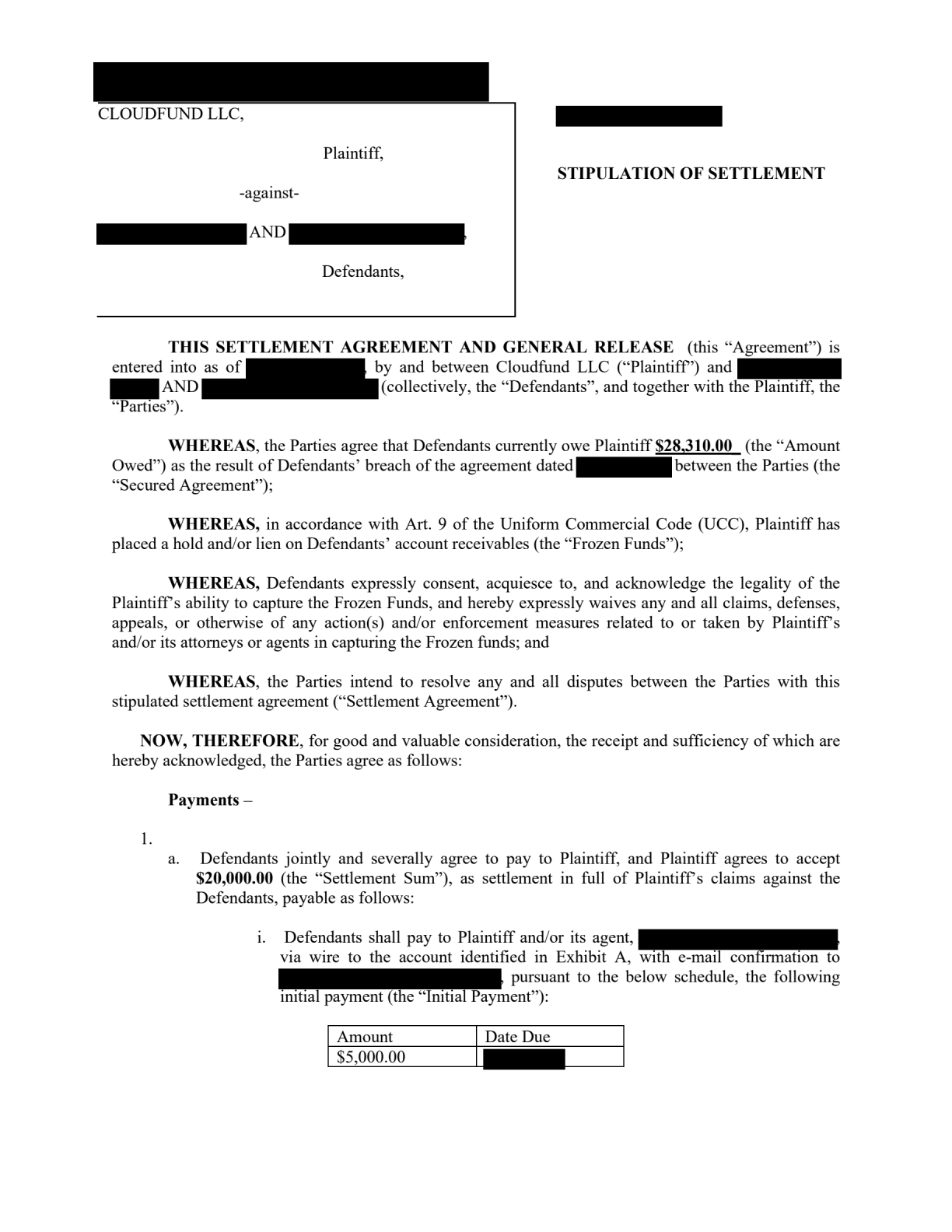
Separate held funds, new payments and release obligations.
First, obtain a dated accounting of funds held, funds transferred and payments already credited. A processor’s reserve balance and a funder’s payment ledger may describe different stages of the same transaction. Ask counsel to reconcile them before evaluating a proposed remaining balance.
Second, read the release mechanism. Who sends the instruction, to which customer or processor, and after which event? A promise to release funds after performance is different from an immediate release. Keep written delivery and receipt records instead of relying only on a phone conversation.
Third, review the general release and any consent language with the payment terms. Identify the claims and parties covered and the rights being given up. If there is a lawsuit, ask what filing or court action will address it. If the business needs access to receipts to make the settlement payments, that dependency needs to be addressed expressly.
Where does your Cloudfund matter stand?
MCA payments are too much
Compare the proposed new payments with receipts the business can actually access, including any processor reserve.
Receivables or accounts are affected
Identify each recipient of a Cloudfund-related notice and obtain a dated record of funds held or remitted.
Court papers have arrived
Review the complaint and any proposed consents together. A settlement discussion does not itself change a court deadline.
Four practical first steps.
- Check for a court deadline.If you received court papers, identify where the case is filed and when a response is due. Settlement discussions do not automatically extend a deadline.
- Put the records in one place.Collect the agreement, payment history, bank statements, and every notice. Preserve emails and texts, including any proposed settlement terms.
- Review a proposed change before signing.A new agreement, acknowledgment, release, or guarantee can affect your rights and obligations. Have its terms reviewed in context.
- Discuss a plan for your actual situation.Ask which legal or negotiation options fit the documents, cash flow, and litigation status—and what representation would cost.
Cloudfund MCA questions, answered.
Does the Cloudfund example mean all frozen funds count toward settlement?
No. The public excerpt describes held receivables, but treatment of particular funds depends on the complete agreement and accounting. Identify whether each amount is held, transferred or already credited before assessing what remains payable.
Will paying a settlement automatically remove a processor restriction?
Do not assume so. Review the agreed release instructions, timing and recipient, then confirm that the processor received and implemented them. A settlement with one party may not resolve another party’s separate restriction.
Why review the general release if the payment amount is acceptable?
It may identify claims, parties and rights being released in addition to the amount to be paid. Those provisions should be understood before signing, especially where an active case or disputed collection activity is involved.
Can I get help before Cloudfund files a lawsuit?
Yes. Bring the agreement, current demand, payment records and customer or processor notices. An attorney can review payment pressure and asserted rights before court papers arrive.
What does the free MCA review cover?
The initial consultation can address your MCA agreement, payment pressure, collection communications or case status. Consultations are free. Any retained legal-service fees are separate and addressed in the engagement terms.
Let’s review your Cloudfund MCA.
Tell us about the payment demand, proposed agreement or court papers you need help understanding.
General information, not legal advice. Options depend on the agreements, facts, applicable law, and procedural history. No result is guaranteed. Contacting the firm does not create an attorney-client relationship or extend a deadline. Business Debt Law Group provides legal services; it does not provide or arrange financing.