
JNG Capital MCA lawsuit or customers holding your payments?

A promise to send release notices is a step in restoring payment flow, not proof that a customer or vendor has already acted. Review who receives the notice, what triggers it and how the ongoing settlement will be funded.
Free MCA review or case evaluation.
No lawsuit is required to ask for help.


The JNG file
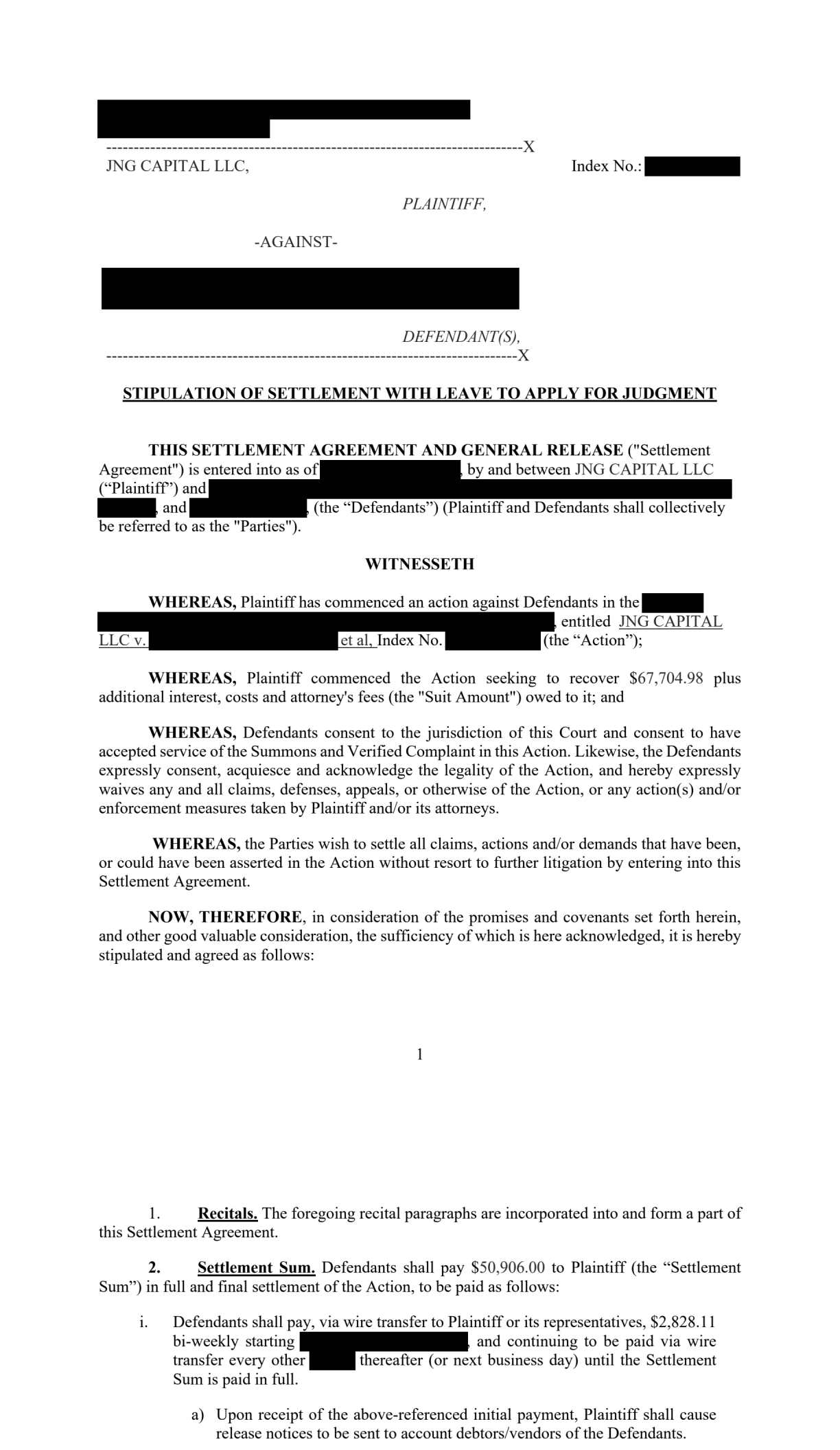
The published excerpt names JNG Capital LLC as plaintiff and describes a settlement of an action. It contains a suit amount, a biweekly wire schedule, jurisdiction and service acknowledgments, and a provision for notices to account debtors or vendors after the initial payment.
The name alone should not be linked to an unrelated investment or financing business. Match the full entity, account and case to your agreement and notices. The public record’s redactions prevent establishing every detail about the underlying transaction or enforcement history.
The initial-payment provision is useful because it separates two actions: making the first payment and having release notices sent. It does not establish when a third party received a notice or resumed payments, and it does not itself show that a UCC financing statement was terminated.
- Named plaintiff
- JNG Capital LLC
- Payment schedule
- Biweekly wires, with the full dated schedule needed
- Release step
- Notices to account debtors or vendors after initial payment
- Independent legal representation
- Business Debt Law Group is not affiliated with, endorsed by, or acting for JNG Capital.
Release notices tied to the first installment
The excerpt states a $67,704.98 suit amount plus additional interest, costs and attorney fees. It describes $50,906 settlement terms using $2,828.11 biweekly wire payments until paid in full. After receipt of the initial payment, it calls for release notices to account debtors or vendors. The excerpt does not establish that payment occurred, that notices were delivered or that third parties released money.
See more MCA settlement examples ↗
Partial, redacted excerpt from one matter. Other pages, amendments and later events may affect these terms. This discussion does not summarize the complete agreement or case. Acceptance, completed payment, releases and the final outcome require verification from the complete records. This is not a standard offer or promised result. Past results do not guarantee a similar outcome.
Follow the release from the agreement to the recipient
Create a list of the customers, processors or vendors affected by each demand and retain the original notices. Compare that list with the recipients covered by the settlement’s release provision. Different restrictions may require different documents; a promise concerning one account debtor should not be assumed to clear every restraint.
Ask who sends each notice, what payment or other condition triggers it, and how delivery and acceptance will be documented. Then confirm the recipient’s processing requirements. This creates a record of the agreed step and its implementation without assuming an instant return of cash flow.
Budget the recurring wires using an every-two-weeks calendar. Confirm the remaining balance, final installment and business-day rules from the complete schedule. If projected payments depend on money being released by third parties, account for that timing explicitly before committing.
Where does your JNG matter stand?
MCA payments are too much
Test the biweekly schedule against available receipts and realistic release timing.
Receivables or accounts are affected
Identify every affected account debtor or vendor and the notice needed to restore payment flow.
Court papers have arrived
Bring the stipulation and docket to review procedural admissions and any remaining deadlines.
Four practical first steps.
- Check for a court deadline.If you received court papers, identify where the case is filed and when a response is due. Settlement discussions do not automatically extend a deadline.
- Put the records in one place.Collect the agreement, payment history, bank statements, and every notice. Preserve emails and texts, including any proposed settlement terms.
- Review a proposed change before signing.A new agreement, acknowledgment, release, or guarantee can affect your rights and obligations. Have its terms reviewed in context.
- Discuss a plan for your actual situation.Ask which legal or negotiation options fit the documents, cash flow, and litigation status—and what representation would cost.
JNG MCA questions, answered.
Does a promised release notice prove money was released?
No. Payment, notice delivery and the recipient’s action are separate events.
Does a release notice necessarily terminate a UCC filing?
No. Review the specific document and obligation. A third-party notice and a financing-statement termination are different records.
Are biweekly payments due twice each month?
Every two weeks is a different schedule from twice per calendar month. Follow the actual dates.
Does this example establish that every JNG matter uses these terms?
No. It is one partial, redacted record and not a standard offer or description of every agreement.
What does the free MCA review cover?
The initial consultation can address your MCA agreement, payment pressure, collection communications or case status. Consultations are free. Any retained legal-service fees are separate and addressed in the engagement terms.
Let’s review your JNG MCA.
Tell us about the payment demand, proposed agreement or court papers you need help understanding.
General information, not legal advice. Options depend on the agreements, facts, applicable law, and procedural history. No result is guaranteed. Contacting the firm does not create an attorney-client relationship or extend a deadline. Business Debt Law Group provides legal services; it does not provide or arrange financing.