
LCF Group MCA Payment Pressure or a Lawsuit?

A new payment arrangement needs to work for your cash flow and say clearly what happens next. If your MCA records refer to LCF Group or Last Chance Funding, Business Debt Law Group can review the agreement, the party seeking payment and any proposed terms before you commit to a new arrangement.
Free MCA review or case evaluation.
No lawsuit is required to ask for help.


The LCF file
An LCF Group or Last Chance Funding payment arrangement needs to work for the business and clearly state what it resolves. A lower number alone does not explain interest, payment methods, court obligations or the consequence of a missed installment.
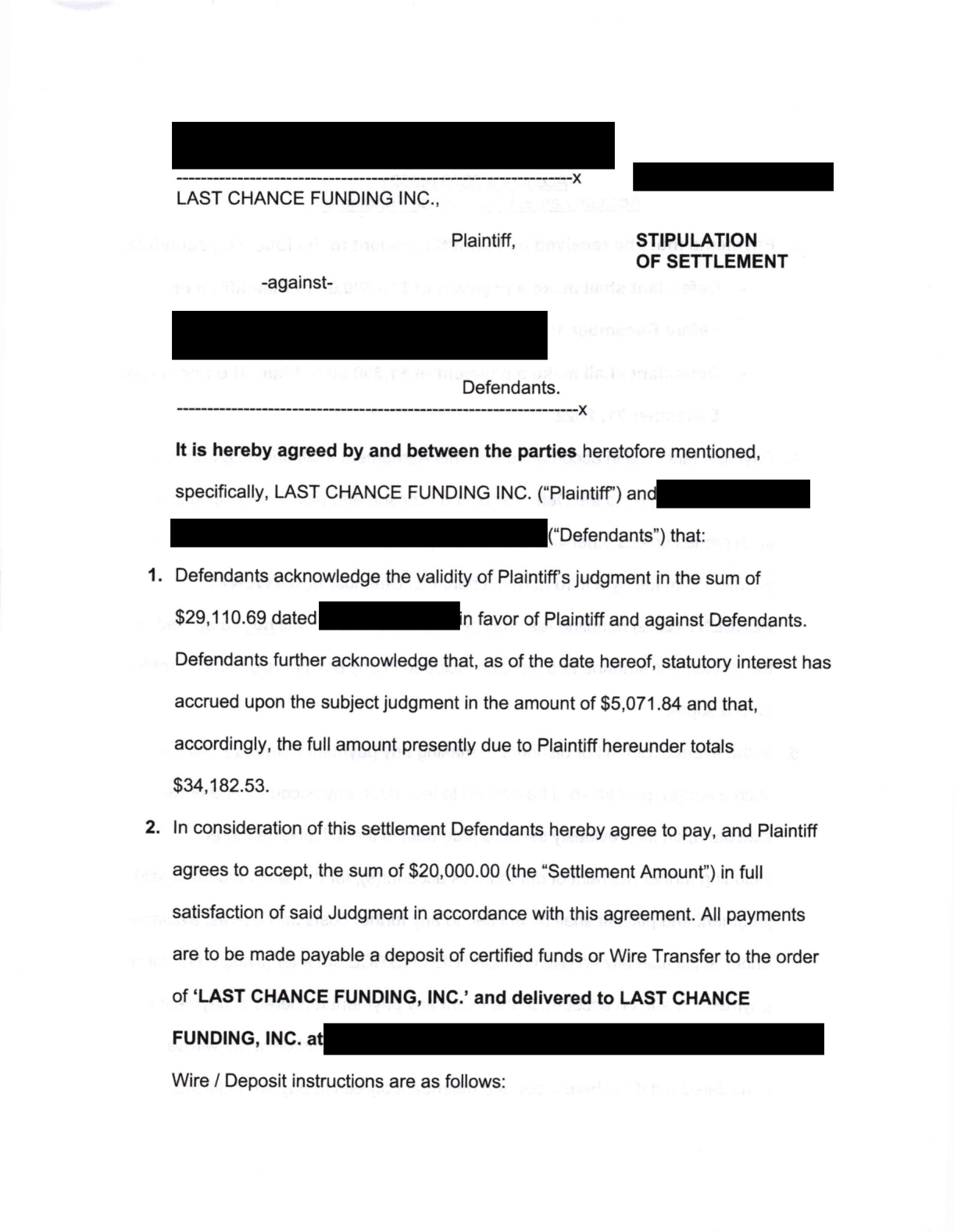
A federal court record identifies LCF Group, Inc. a/k/a Last Chance Funding Group, Inc. The public settlement excerpt below names Last Chance Funding Inc. These are useful references when organizing your records, but an attorney should compare the exact name on your agreement, notices and court papers rather than treating every variation as interchangeable.
Start with the most recent document. A collection email, summons, arbitration demand and judgment call for different reviews. Tell the attorney which one you have, when you received it and whether a bank account or incoming receivable is currently affected.
Sources: Federal court record identifying LCF / Last Chance Funding (2023)
- Names to compare
- LCF Group and Last Chance Funding, including the full entity name on your documents.
- Main review issue
- The payment schedule, included charges and conditions for completing a resolution.
- Document below
- Documented settlement terms with interest and payment-method qualifications.
- Independent legal representation
- Business Debt Law Group is not affiliated with, endorsed by, or acting for LCF Group.
Last Chance Funding terms, with the qualifications.
BDLG’s published example compares $20,000 in settlement terms with $34,182.53, including accrued interest. The public record also notes that an additional handling fee may apply to unauthorized third-party payments. These qualifications belong to this example; they are not stated as universal LCF terms.
See more MCA settlement examples ↗
Partial, redacted excerpt from one matter. Other pages, amendments and later events may affect these terms. This discussion does not summarize the complete agreement or case. Acceptance, completed payment, releases and the final outcome require verification from the complete records. This is not a standard offer or promised result. Past results do not guarantee a similar outcome.
Before accepting a new schedule, settle these questions.
Ask whether the proposed total includes interest and other charges; whether payments must come from a particular account or source; and when a payment counts as received. Then compare each due date with expected receipts and the other MCA withdrawals the business must address. A schedule that immediately fails may create further disputes.
The resolution should also explain what happens to any pending case, existing judgment or collection instruction. If an arbitration notice or award is involved, send the entire document for review. Do not assume that an email negotiating payments suspends that proceeding or extends a court deadline.
Where does your LCF matter stand?
MCA payments are too much
Review receipts, overlapping advances and any reconciliation request before committing to another arrangement.
Receivables or accounts are affected
Bring the actual MCA UCC, customer, processor or bank notice so the source and scope of the restriction can be assessed.
Court papers have arrived
Identify the court, parties, service details and response requirements promptly. Negotiations do not automatically extend a deadline.
Four practical first steps.
- Check for a court deadline.If you received court papers, identify where the case is filed and when a response is due. Settlement discussions do not automatically extend a deadline.
- Put the records in one place.Collect the agreement, payment history, bank statements, and every notice. Preserve emails and texts, including any proposed settlement terms.
- Review a proposed change before signing.A new agreement, acknowledgment, release, or guarantee can affect your rights and obligations. Have its terms reviewed in context.
- Discuss a plan for your actual situation.Ask which legal or negotiation options fit the documents, cash flow, and litigation status—and what representation would cost.
LCF MCA questions, answered.
Why do my records mention both LCF Group and Last Chance Funding?
Public court records connect those names, but your matter still requires checking the exact contracting party, any assignment and the entity seeking payment. Include every version of the agreement and notice you received.
Does the $20,000 example include every possible fee?
Do not assume so. The public comparison includes accrued interest and notes a possible handling fee for unauthorized third-party payments. Review the complete agreement for the total obligation and any conditions that could change it.
What if I received an arbitration demand instead of a lawsuit?
Send the demand, arbitration clause, service details and any communications about a hearing or response date. Arbitration and court proceedings have different procedures. The applicable deadline and response need to be determined from your documents.
Can I use another company’s funds to make a settlement payment?
Have the permitted payment source and method checked first. The example on this page specifically includes a qualification about unauthorized third-party payments. Do not apply that condition to your matter without reading your own terms.
What does the free MCA review cover?
The initial consultation can address your MCA agreement, payment pressure, collection communications or case status. Consultations are free. Any retained legal-service fees are separate and addressed in the engagement terms.
Let’s review your LCF MCA.
Tell us about the payment demand, proposed agreement or court papers you need help understanding.
General information, not legal advice. Options depend on the agreements, facts, applicable law, and procedural history. No result is guaranteed. Contacting the firm does not create an attorney-client relationship or extend a deadline. Business Debt Law Group provides legal services; it does not provide or arrange financing.