
Parkview Advance Lawsuit involving more than one MCA?

A Parkview claim can require a separate accounting for each agreement. We review funding, payment credits, default allegations and added charges before assessing the demand or a settlement proposal.
Free MCA review or case evaluation.
No lawsuit is required to ask for help.


The Parkview file
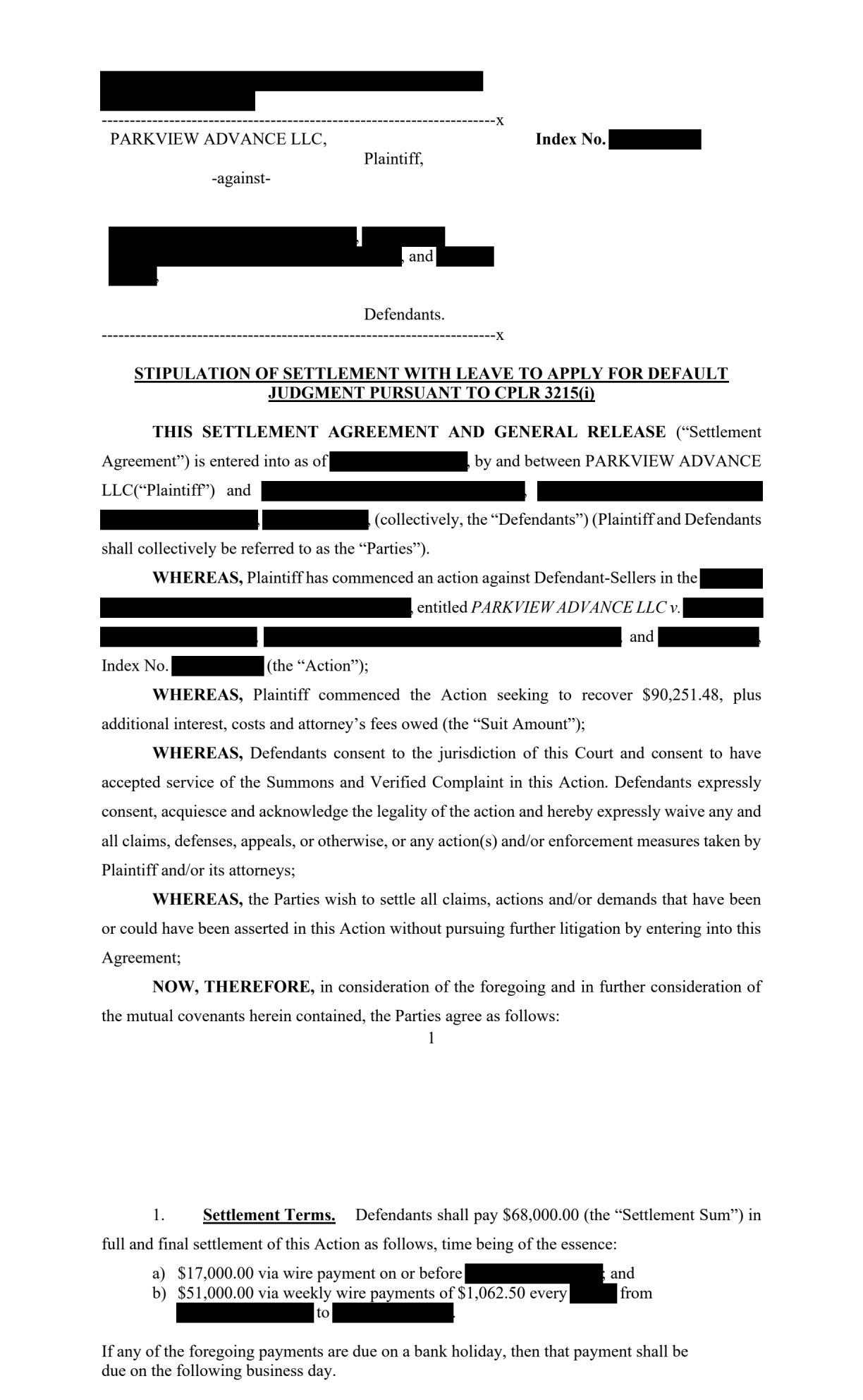
Our redacted example names Parkview Advance LLC and concerns a proposed resolution of a contract claim. The comparison amount excludes additional interest, costs and attorney fees, so it should not be presented as an all-inclusive judgment figure.
Two 2026 Kings County decisions show why liability and the amount owed are separate questions. In TFB Option, Parkview obtained summary judgment on liability only; the court found unexplained balance discrepancies and denied the requested default fees. In Comstock Energy, the court granted summary judgment with default fees removed and required itemization for four agreements. These are particular rulings, not a rule that all Parkview charges or claims fail.
Sources: Parkview Advance LLC v. TFB Option (2026) · Parkview Advance LLC v. Comstock Energy LLC (2026)
- Entity in the excerpt
- Parkview Advance LLC.
- Separate balances
- Identify funding, credits and claimed charges for each agreement.
- Document distinction
- A proposed settlement, a liability ruling and an entered money judgment are different records.
- Independent legal representation
- Business Debt Law Group is not affiliated with, endorsed by, or acting for Parkview Advance.
A Parkview proposal starts with a defined comparison amount.
Our published library records $68,000 in proposed settlement terms against a $90,251.48 comparison amount. The comparison excludes additional interest, costs and attorney fees. The excerpt includes litigation-related terms; neither acceptance nor payment completion should be assumed from the displayed pages.
See more MCA settlement examples ↗
Partial, redacted excerpt from one matter. Other pages, amendments and later events may affect these terms. This discussion does not summarize the complete agreement or case. Acceptance, completed payment, releases and the final outcome require verification from the complete records. This is not a standard offer or promised result. Past results do not guarantee a similar outcome.
Make one timeline, with a separate ledger for each advance.
When a later advance arrives, confirm in writing whether an earlier balance was paid off, reduced or left in place. Compare the net deposit, payoff instructions and subsequent withdrawals. A merchant’s expectation that one debit will replace another should be tested against the actual documents.
In Comstock Energy, the court rejected the merchant’s asserted payoff understanding because the second agreement did not support it. That example makes the payoff paperwork especially useful. It does not establish what happened on your account or remove the need to review your own payment history.
Separate purchased-receivables balances from default charges, legal fees and interest. Ask for the calculation behind each category. If court papers seek one amount while attachments show another, identify the discrepancy precisely rather than assuming that it ends the case.
Where does your Parkview matter stand?
MCA payments are too much
List each active Parkview debit and whether a later transaction was supposed to replace it.
Receivables or accounts are affected
Trace which agreement is referenced in a notice directed to your bank or customer.
Court papers have arrived
Bring every contract attached to the complaint, not only the most recent one.
Four practical first steps.
- Check for a court deadline.If you received court papers, identify where the case is filed and when a response is due. Settlement discussions do not automatically extend a deadline.
- Put the records in one place.Collect the agreement, payment history, bank statements, and every notice. Preserve emails and texts, including any proposed settlement terms.
- Review a proposed change before signing.A new agreement, acknowledgment, release, or guarantee can affect your rights and obligations. Have its terms reviewed in context.
- Discuss a plan for your actual situation.Ask which legal or negotiation options fit the documents, cash flow, and litigation status—and what representation would cost.
Parkview MCA questions, answered.
Does a new Parkview advance automatically close the old one?
Do not assume so. Check the payoff instructions, contract terms and subsequent ledger. A new deposit alone does not identify which prior obligations were resolved.
Does a favorable ruling on fees mean the lawsuit is over?
No. The cited cases distinguish fees or damages from other parts of the claim. Read the order’s actual scope and check the current docket.
Is the $68,000 proposal a completed settlement result?
It is documented as proposed terms in our library. The public excerpt does not establish acceptance or completed payment.
What helps an attorney review multiple agreements quickly?
A dated list of each agreement, gross and net funding, stated purchased amount, payments and any promised payoff is a useful starting point. Preserve the source records behind that list.
What does the free MCA review cover?
The initial consultation can address your MCA agreement, payment pressure, collection communications or case status. Consultations are free. Any retained legal-service fees are separate and addressed in the engagement terms.
Let’s review your Parkview MCA.
Tell us about the payment demand, proposed agreement or court papers you need help understanding.
General information, not legal advice. Options depend on the agreements, facts, applicable law, and procedural history. No result is guaranteed. Contacting the firm does not create an attorney-client relationship or extend a deadline. Business Debt Law Group provides legal services; it does not provide or arrange financing.