
Specialty Capital Lawsuit or held-fund settlement proposal?

A Specialty Capital proposal may combine money already held with new installments. Our attorneys review how each payment is credited and what records support any reconciliation or contract dispute.
Free MCA review or case evaluation.
No lawsuit is required to ask for help.


The Specialty file
The excerpt in our settlement library names Specialty Capital LLC and a receivables purchase agreement. It separates a release of held money from later payments, which matters when calculating the new cash the business must provide.
In Specialty Capital, LLC v. Gregory T. Harvey DDS, Inc. (2024), the court granted judgment on the agreement and guaranty but denied a $5,000 default fee. The decision also noted the absence of evidence supporting a claimed written reconciliation request. The ruling concerns that record; it is not a finding about every Specialty agreement.
Sources: Specialty Capital, LLC v. Gregory T. Harvey DDS, Inc. (2024)
- Entity shown
- Specialty Capital LLC.
- Funding of the proposal
- $1,000 from held funds plus $11,000 in installments.
- Evidence to preserve
- Written reconciliation requests, supporting statements and replies.
- Independent legal representation
- Business Debt Law Group is not affiliated with, endorsed by, or acting for Specialty Capital.
The Specialty example uses held funds as part of the total.
The library identifies proposed terms totaling $12,000: $1,000 released from held funds and $11,000 in installments. The displayed document refers to a separate form for the held-fund transfer. That amount is part of the stated settlement, not an additional discount or an extra payment outside the total.
See more MCA settlement examples ↗
Partial, redacted excerpt from one matter. Other pages, amendments and later events may affect these terms. This discussion does not summarize the complete agreement or case. Acceptance, completed payment, releases and the final outcome require verification from the complete records. This is not a standard offer or promised result. Past results do not guarantee a similar outcome.
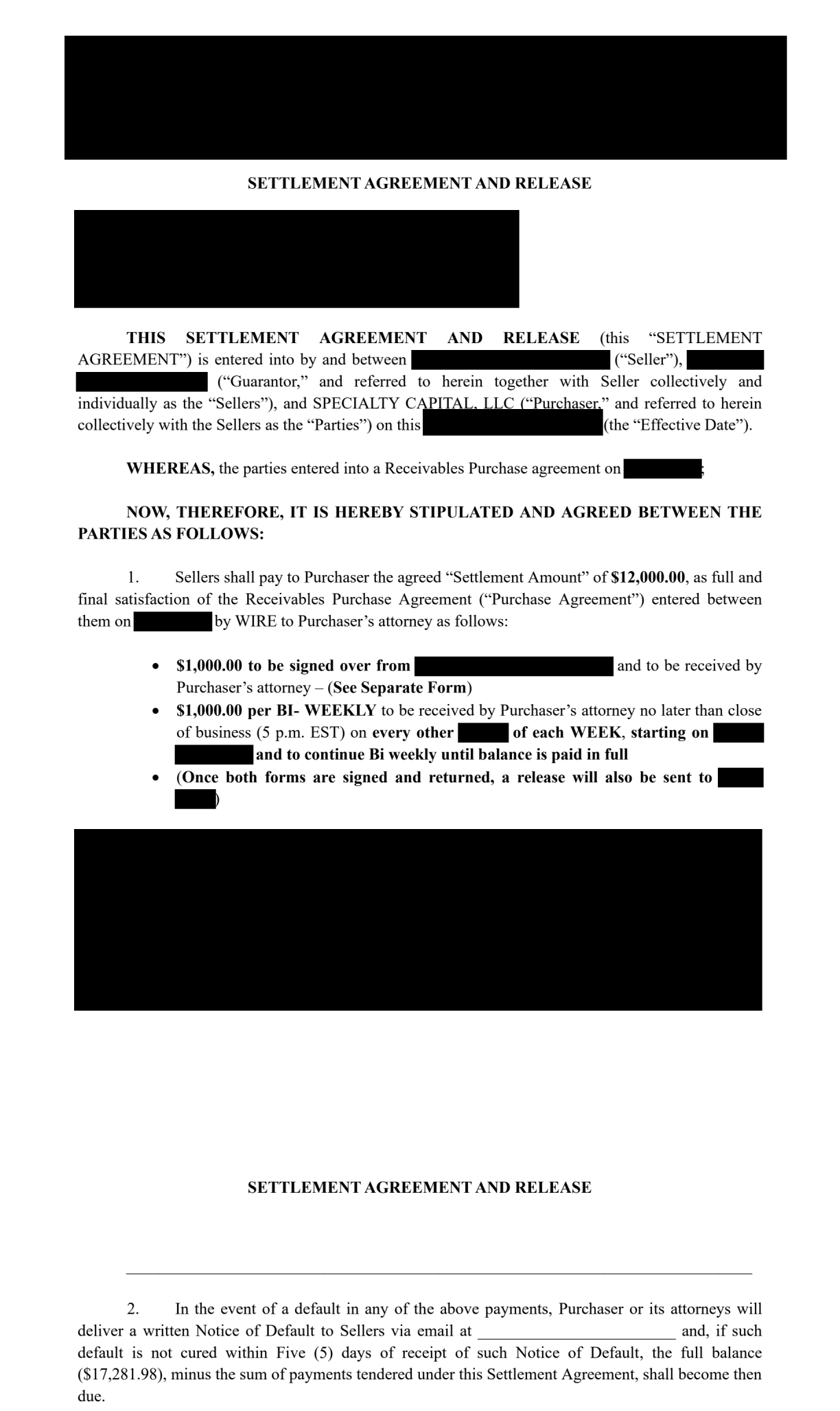
Track who receives the held funds and when the credit appears.
Obtain the separate authorization or release form referenced in the proposal. Confirm the holder, recipient, amount and timing, then match the transfer to the settlement ledger. A release to the funder and a release back to the merchant have different cash-flow effects.
Use the schedule’s actual wording when projecting future withdrawals. The excerpt refers to biweekly installments; do not turn that into twice-monthly dates without checking the complete plan. Ask how the final installment, returned payments and previously held amounts are handled.
For a payment-adjustment dispute, collect the dated request, its attachments, the delivery record and the response together. Bank statements showing lower receipts and proof that a request was sent serve different purposes. A complete record lets counsel evaluate both the clause and how it was used.
Where does your Specialty matter stand?
MCA payments are too much
Calculate the new cash required after any confirmed held-fund credit.
Receivables or accounts are affected
Review the separate release form before treating a restraint or hold as resolved.
Court papers have arrived
Bring written requests and supporting records alongside the complaint and guaranty.
Four practical first steps.
- Check for a court deadline.If you received court papers, identify where the case is filed and when a response is due. Settlement discussions do not automatically extend a deadline.
- Put the records in one place.Collect the agreement, payment history, bank statements, and every notice. Preserve emails and texts, including any proposed settlement terms.
- Review a proposed change before signing.A new agreement, acknowledgment, release, or guarantee can affect your rights and obligations. Have its terms reviewed in context.
- Discuss a plan for your actual situation.Ask which legal or negotiation options fit the documents, cash flow, and litigation status—and what representation would cost.
Specialty MCA questions, answered.
Is the held $1,000 in addition to the $12,000 proposal?
The published example describes it as part of the total, with $11,000 in installments. Confirm the complete terms and actual credits for your matter.
Does a release mean the held money returns to my business?
Not necessarily. Identify the recipient in the authorization. A transfer to the funder can reduce the balance without providing cash back to the merchant.
What if I discussed reconciliation only by phone?
Preserve notes and any follow-up messages, and have counsel review the required procedure. Do not create or backdate a request; distinguish what was said from what can be documented.
Did the cited court dismiss the Specialty claim?
No. It granted judgment while denying the requested default fee. A limited ruling on a charge is different from dismissal of the underlying claim.
What does the free MCA review cover?
The initial consultation can address your MCA agreement, payment pressure, collection communications or case status. Consultations are free. Any retained legal-service fees are separate and addressed in the engagement terms.
Let’s review your Specialty MCA.
Tell us about the payment demand, proposed agreement or court papers you need help understanding.
General information, not legal advice. Options depend on the agreements, facts, applicable law, and procedural history. No result is guaranteed. Contacting the firm does not create an attorney-client relationship or extend a deadline. Business Debt Law Group provides legal services; it does not provide or arrange financing.