
What to Expect and How to Contend With High-Pressure and Aggressive Merchant Cash Advance Collection Tactics
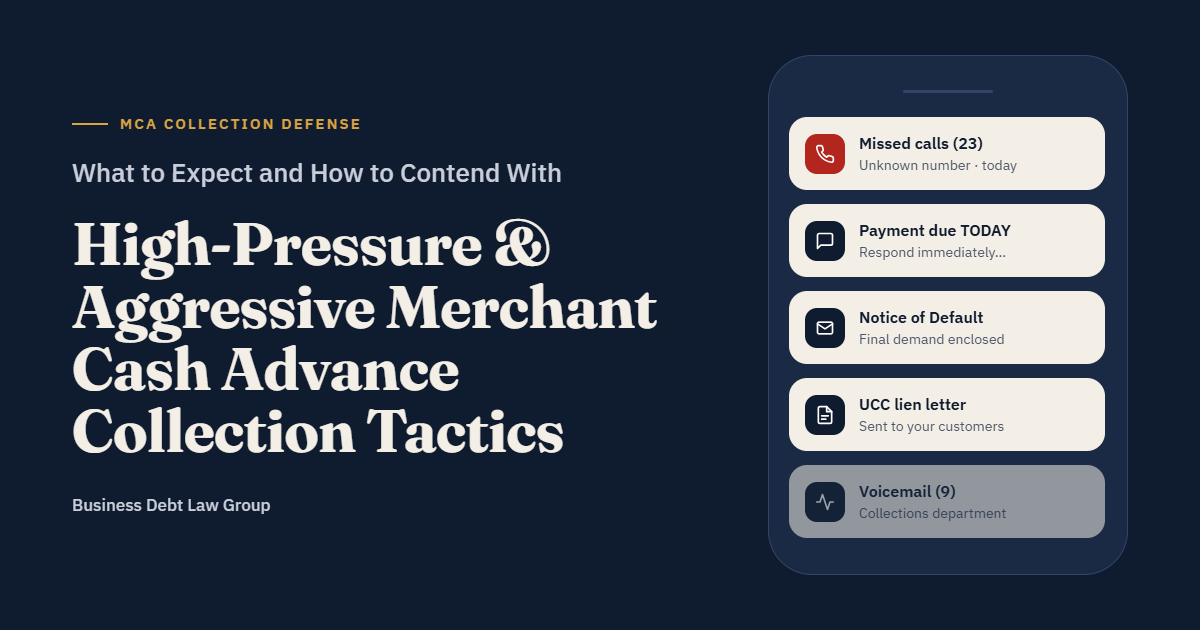
MCA collection pressure can begin before a missed payment and escalate quickly once one occurs. Here is what business owners can expect and how to respond.
This article provides insight and information for business owners dealing with Merchant Cash Advance (MCA) obligations or considering their options when MCA payments begin placing pressure on business cash flow. Merchant cash advances are commercial financing arrangements and may be structured as purchases of future receivables or revenue rather than traditional business loans.
The first thing to recognize is that MCA transactions can operate differently from traditional bank financing. Banks and traditional finance companies operate within federal and state regulatory frameworks. Although many consumer-debt protections may not apply to commercial MCA obligations in the same manner they apply to consumer debt, MCA providers and their collection representatives do not operate entirely outside federal or state law. The laws that may apply depend on the transaction, parties, conduct involved, and jurisdiction.
MCA Creditor Pressure May Begin Before a Missed Payment
We can begin by stating that the MCA creditor pressure may begin even before a business owner misses an MCA payment. When a business accepts a merchant cash advance and receives its funding amount, the agreement may provide for either daily or weekly payments or remittances. Depending on the agreement, the MCA provider may have ACH authorization to withdraw these amounts from the business bank account.
Very typically, brokers and/or collection representatives may remain in contact with the business owner even if a payment has not been missed, with regular communications such as “Are you going to make your payment timely this week?” “Are you going to make your payment today?” “Are you having any financial difficulty with payments that you need to tell us about?”
MCA Providers Can Monitor Business Payment and Cash-Flow Activity
A broker or MCA provider can offer the business owner another merchant cash advance when the business is already struggling to maintain its daily or weekly payments.
Depending on the agreement and financial information provided in connection with the MCA, the provider can have access to business banking or financial information. That information can provide insight into deposits, cash-flow patterns, payment activity, and the overall financial condition of the business.
When the account activity begins showing signs of financial difficulty, communications from the MCA provider can increase even before a payment is missed. The business owner can therefore begin experiencing creditor pressure before an actual payment default occurs.
MCA Provider Might Offer a New Advance with a Higher Repayment or Stacking
When cash-flow shortages make an existing Merchant Cash Advance increasingly difficult to maintain, the MCA provider can offer the business another, higher-dollar advance.
The provider can offer to address an existing or delinquent advance through new funding, or it can provide another Merchant Cash Advance while the existing obligation remains outstanding.
Adding a second, third, or even fourth advance while earlier MCA agreements remain outstanding is commonly referred to as “stacking.”
Once a business begins stacking Merchant Cash Advance agreements, the financial pressure can increase quickly.
A business starts with one MCA, struggles to maintain the payments, and then accepts a second advance that provides short-term cash-flow relief but also creates another payment obligation. A third or fourth advance further increases the number and amount of daily or weekly payments affecting the business’s operational cash flow.
Consider the logic.
A business already struggling to maintain one advance now has to manage payments under several MCA agreements at the same time. This dramatically increases the amount of ACH withdrawals being pulled daily or weekly from the business account and further weakens its cash-flow position.
While stacked advances can provide short-term access to additional capital, they also increase the business’s overall financial obligations and can make an existing cash-flow problem significantly more difficult to manage.
Missed MCA Payments Are Often When Greater Collection Pressure Begins
Once a business misses or has a daily or weekly payment returned, collection pressure can increase significantly.
If a business is already struggling with one MCA obligation or has stacked advances and can no longer maintain multiple daily or weekly payments, more aggressive collection activity can follow.
A business owner can experience a significant increase in telephone calls, text messages, emails, voicemails, payment demands, and default notices. Some business owners report repeated communications throughout the day.
These communications can include demands for immediate payment and statements concerning potential collection or enforcement actions.
Repeated Calls, Text Messages, and Collection Communications
The commercial nature of an MCA obligation does not mean an MCA provider or collection representative is legally free to say or do anything in an effort to collect.
Federal and state laws can apply depending on the conduct, parties, jurisdiction, and circumstances involved.
Business owners should preserve threatening or potentially misleading communications, including text messages, emails, voicemails, and written notices. These communications can then be reviewed together with the MCA agreement and applicable law.
Contact With Family Members or Other Third Parties
Collection pressure is not always limited to communications directly with the business owner.
In some MCA disputes, business owners report that funders or their representatives contact family members or other third parties in an effort to reach or place additional pressure on the business owner.
The legal significance of particular third-party communications depends on the conduct, circumstances, and applicable law.
MCA Funders Can Contact a Business’s Customers
Another significant collection issue involves communications with a business’s customers.
Depending on the agreement and rights being asserted, an MCA provider or its representative can contact customers or send notices seeking payment of receivables, including communications based on an asserted UCC security interest.
These communications can create additional pressure because customer relationships are often critical to the continued operation of the business.
UCC Filings and MCA Collection Activity
UCC filings are another important issue in merchant cash advance disputes.
An MCA agreement can contain provisions concerning security interests in specified business assets, accounts, or receivables, and a UCC financing statement can be filed in connection with the transaction.
The existence of a UCC filing, however, does not by itself determine whether every claimed enforcement action is valid.
The underlying MCA agreement, collateral provisions, UCC filing history, payment records, and applicable law need to be reviewed together.
A public UCC filing alone does not establish the amount owed, the scope of enforceable collateral, lien priority, or whether a particular action involving customers, receivables, bank accounts, or payment processors is legally permissible.
How MCA Collection Pressure Differs From Consumer Debt Collection
MCA creditor pressure is different from the type of collection pressure a person experiences with consumer debt or certain traditional financing arrangements.
Banks and other regulated financial institutions operate within federal and state regulatory frameworks. Commercial MCA obligations, by contrast, do not receive all of the consumer-debt protections applicable to debts incurred primarily for personal, family, or household purposes.
That distinction does not mean MCA providers are exempt from federal or state law.
Government enforcement actions have addressed conduct in the MCA industry involving deceptive representations, unauthorized withdrawals, threats, and unfair collection practices. Whether particular conduct violates the law depends on the facts, parties, jurisdiction, and applicable law.
Can MCA Funders Contact You After You Hire an Attorney?
Retaining an attorney does not necessarily create the same restrictions on direct communications in a commercial MCA matter that can apply in certain consumer-debt matters.
Whether an MCA provider, collection representative, or attorney can communicate directly with a represented business owner depends on who is communicating, the nature of the obligation, applicable law and professional-conduct rules, and whether litigation has been filed.
For that reason, retaining an MCA attorney does not automatically stop every telephone call, text message, or other communication.
Threats of Asset Seizure, Fraud, or Other Legal Action
After a payment problem develops, collection communications can include threats concerning lawsuits, UCC-related actions, business assets, personal guarantees, or allegations of fraud.
Some business owners also receive aggressive statements concerning the potential consequences of failing to make payment.
Such statements should not automatically be accepted as legal conclusions.
Whether an MCA provider has the legal right to take a threatened action depends on the MCA agreement, applicable law, UCC filings, guarantees, pending court proceedings, and the specific circumstances.
Likewise, an allegation of fraud made during a collection communication does not, by itself, establish that fraud occurred.
What Should a Business Owner Do When Facing MCA Creditor Pressure?
If a business is facing significant MCA collection pressure, it is important to preserve the MCA agreements, amendments, personal guarantees, payment records, bank statements, ACH withdrawal history, reconciliation requests, default notices, emails, text messages, voicemails, UCC filings, and customer or processor communications.
If a lawsuit has been filed, the complaint, summons, service information, court deadlines, judgments, and other legal documents should also be preserved.
These records allow an attorney to evaluate the MCA agreement, payment history, actions taken by the funder, and current status of the matter.
Can Problematic MCA Obligations Be Negotiated or Settled?
Depending on the circumstances, a business facing problematic MCA obligations can have potential negotiation, settlement, restructuring, reconciliation, litigation-defense, or other legal options.
There is no single strategy that applies to every merchant cash advance matter.
The appropriate approach depends on the MCA agreements, payment history, claimed outstanding balances, business cash flow, stacked obligations, UCC filings, personal guarantees, reconciliation history, funder actions, and whether litigation has already been filed.
Where appropriate, legal counsel can communicate with MCA funders or their representatives to explore potential settlement or revised payment arrangements.
No particular settlement amount, payment reduction, or legal outcome can be guaranteed.
Speak With Business Debt Law Group About MCA Creditor Pressure
In sum, MCA collection pressure can become significant when a business begins experiencing payment problems. Business owners can face repeated communications, demands for payment, threats of legal action, UCC-related issues, customer communications, and other collection activity.
The legality and enforceability of any particular action depend on the MCA agreement, conduct involved, applicable law, and specific circumstances.
The merchant cash advance attorneys at Business Debt Law Group provide consultations to business owners facing MCA payment and collection problems. Our attorneys review MCA agreements, payment history, funder communications, UCC filings, personal guarantees, financial circumstances, and related legal proceedings to evaluate potential legal, negotiation, settlement, or restructuring strategies.
If you believe your business could default on a merchant cash advance, or aggressive collection activity has already begun, consulting with qualified legal counsel can help you understand your agreement, the actions being taken by the MCA provider, and the options available based on your circumstances.
Facing repeated collection demands or payments your business cannot sustain? Free MCA review or case evaluation. No lawsuit is required.
General information, not legal advice. Contacting the firm does not create an attorney-client relationship. Results depend on the facts and applicable law.
Frequently Asked Questions About MCA Creditor Pressure
What happens if I miss a merchant cash advance payment?
A missed or returned MCA payment can trigger increased collection activity, including calls, texts, emails, payment demands, and default notices. The MCA provider may also assert remedies under the agreement. The specific consequences depend on the MCA agreement, payment history, UCC filings, personal guarantees, funder actions, and applicable law.
What is merchant cash advance stacking?
MCA stacking occurs when a business has multiple Merchant Cash Advance agreements outstanding at the same time. A second or third advance can provide short-term cash flow, but it also adds additional daily or weekly payment obligations. Multiple ACH withdrawals can place substantial pressure on the cash a business needs for payroll, vendors, rent, inventory, taxes, and other operating expenses.
Can an MCA provider contact my customers?
Customer communications can arise in MCA disputes, particularly when a provider asserts rights involving receivables or a UCC security interest. The existence of a UCC filing does not automatically establish that every customer communication or collection action is enforceable. The MCA agreement, collateral provisions, UCC filing history, communication itself, and applicable law should be reviewed together.
Can an MCA provider contact my family members or other third parties?
Business owners sometimes report collection communications involving family members or other third parties. Whether a particular communication is legally permissible depends on who made the contact, what was communicated, the purpose of the contact, applicable law, and the surrounding circumstances. Keep copies or records of these communications for legal review.
Does a UCC filing mean the MCA provider can seize my business assets?
Not automatically. A UCC financing statement generally serves a notice and perfection function and does not, by itself, determine the amount owed, the scope of enforceable collateral, lien priority, or whether a particular enforcement action is valid. The underlying MCA agreement, security provisions, filing history, and applicable law are important to the analysis.
Can an MCA provider accuse a business owner of fraud after a missed payment?
An MCA provider or collection representative can make allegations during a dispute, but an allegation of fraud does not establish that fraud occurred. Fraud has specific legal requirements. Threats or allegations should be evaluated against the MCA agreement, payment history, communications, representations made by the parties, and applicable law rather than accepted as legal conclusions.
Will hiring an MCA attorney stop collection calls?
Not necessarily. Commercial MCA obligations do not always carry the same restrictions on direct communications that apply in certain consumer-debt matters. The rules depend on who is communicating, the nature of the obligation, applicable law and professional-conduct rules, and whether litigation has been filed. An attorney can review the collection activity and communicate with the MCA provider or its representatives where appropriate.
Can merchant cash advance obligations be negotiated or settled?
MCA obligations can be subject to negotiation, settlement, restructuring, reconciliation, litigation defense, or other legal strategies depending on the circumstances. An attorney can review the MCA agreements, payment history, business cash flow, stacked obligations, UCC filings, personal guarantees, funder actions, and litigation status to determine which options are appropriate. No particular settlement amount or outcome can be guaranteed.
What should I do if MCA collection pressure becomes aggressive?
Preserve your MCA agreements, amendments, personal guarantees, bank statements, ACH withdrawal records, payment history, reconciliation requests, UCC filings, default notices, emails, texts, voicemails, and customer or processor communications. If you receive a lawsuit, summons, judgment, bank notice, or other court document, preserve it and identify any response deadlines. These records allow an attorney to evaluate the agreement and actions being taken by the MCA provider.
When should I speak with a merchant cash advance attorney?
Consider seeking legal advice when daily or weekly MCA payments are becoming difficult to maintain, your business has multiple stacked MCAs, collection pressure is increasing, customers or third parties are being contacted, a UCC or personal-guarantee issue arises, or litigation has been threatened or filed. Early review gives the attorney an opportunity to evaluate the agreements and circumstances before the matter progresses further.